Operational inefficiencies were costing TD Bank heavily. With transaction failure rates at 0.16% and downtime translating into substantial financial losses, the bank needed a more intelligent approach to IT operations. By centralizing AIOps through Dynatrace, TD Bank reduced transaction failures to 0.06%, improved proactive incident detection by 25%, and accelerated response times by 20%, strengthening service reliability at scale.
This transformation reflects a larger enterprise trend.
“Stack Overflow’s 2024 Developer Survey highlights that over 80% of developers view productivity improvement as the most significant advantage of adopting AI-driven tools.”
As enterprises operate across hybrid cloud infrastructures, microservices, and legacy environments, traditional monitoring methods struggle to keep pace with the sheer volume of operational data.
AIOps tools address this challenge by enabling intelligent observability, predictive analytics, and automated remediation. They empower organizations to minimize downtime, optimize costs, and enhance operational agility. In this blog, we’ll cover what AIOps tools are, their strategic importance, leading platforms in the market, and key considerations for choosing the right solution.
What Is AIOps?
AIOps, or Artificial Intelligence for IT Operations, refers to the use of AI-driven technologies to streamline and optimize IT operations. It brings together artificial intelligence, machine learning, and advanced data analytics to help IT teams monitor, analyze, and manage increasingly complex digital environments. By processing large volumes of operational
Data from multiple systems in real time, AIOps enables faster decision-making and reduces dependence on manual processes.
With AIOps in place, organizations can automatically identify unusual behavior, connect related events across systems, uncover the root causes of issues, and trigger corrective actions with minimal human involvement. This leads to more reliable systems, improved operational efficiency, and quicker incident resolution.
The concept of AIOps was introduced by Gartner in 2016 to describe the application of AI and machine learning within IT operations. Since then, AIOps platforms have evolved to continuously observe IT ecosystems, learn from patterns in data, and proactively surface potential problems before they disrupt business operations.
“As early as 2020, Mordor Intelligence projected strong growth for the AIOps market, estimating it would expand from around $13.5 billion in 2020 to more than $40 billion by 2026.”
How AIOps Works: Core Capabilities and Processes
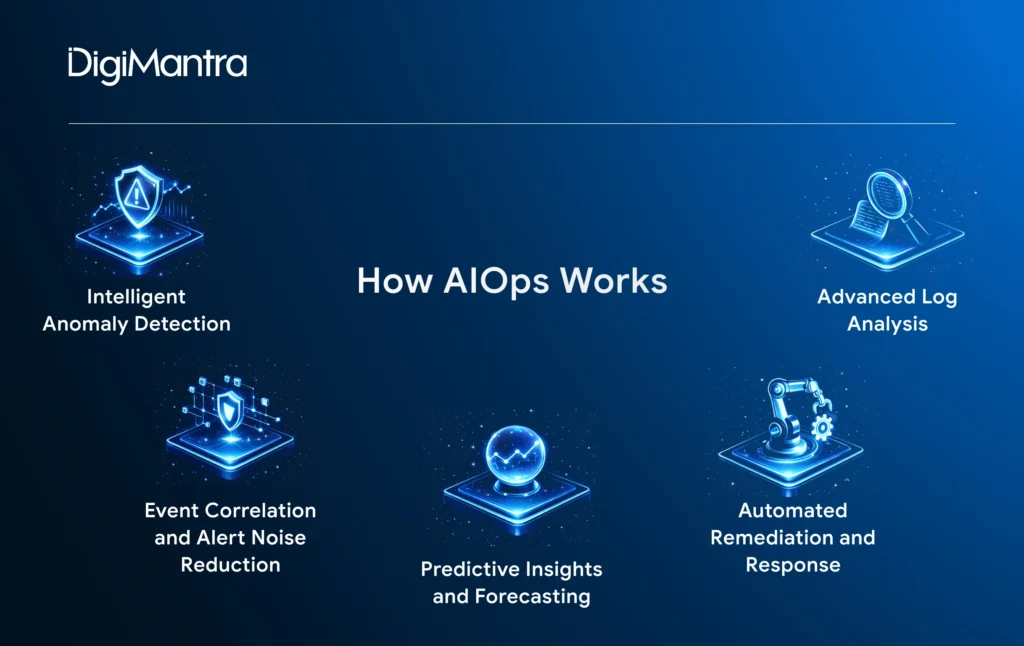
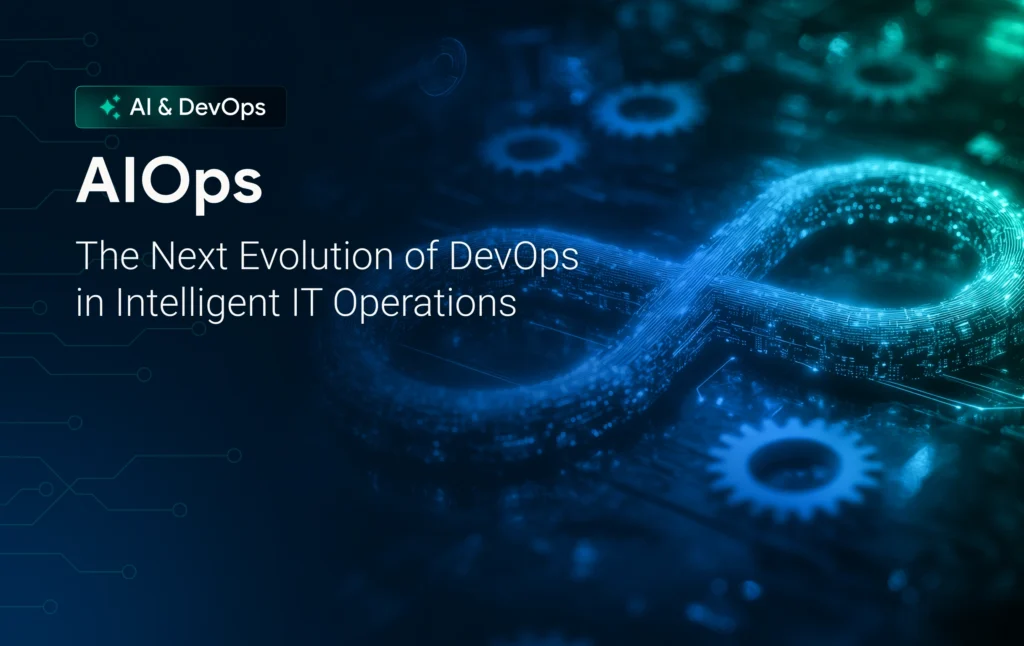
AIOps platforms and tools enable intelligent IT operations and enterprise DevOps transformation through AI-powered insights.
Intelligent Anomaly Detection
AIOps tools constantly analyze data from applications, infrastructure, and monitoring systems to spot behavior that falls outside normal patterns. By identifying issues early, enterprise AIOps platforms help prevent performance slowdowns and outages before users are affected.
Event Correlation and Alert Noise Reduction
Modern AIOps platforms connect signals across multiple systems to understand which alerts are related and which can be ignored. This smart correlation reduces alert overload and helps IT teams focus on the incidents that actually require attention.
Predictive Insights and Forecasting
Using historical trends combined with live data, AIOps tools can anticipate failures, capacity constraints, and performance risks. This forward-looking approach allows teams to take preventive action and allocate resources more effectively.
Automated Remediation and Response
Once the root cause is identified, enterprise AIOps solutions can automatically trigger corrective actions such as restarting services or adjusting configurations. Automation reduces manual effort, speeds up resolution, and minimizes downtime.
Advanced Log Analysis
AIOps platforms collect and standardize logs from across the IT stack and apply machine learning to uncover errors, bottlenecks, and hidden patterns. This deeper visibility helps teams identify issues that traditional monitoring tools often overlook.
Top AIOps Platforms & Tools
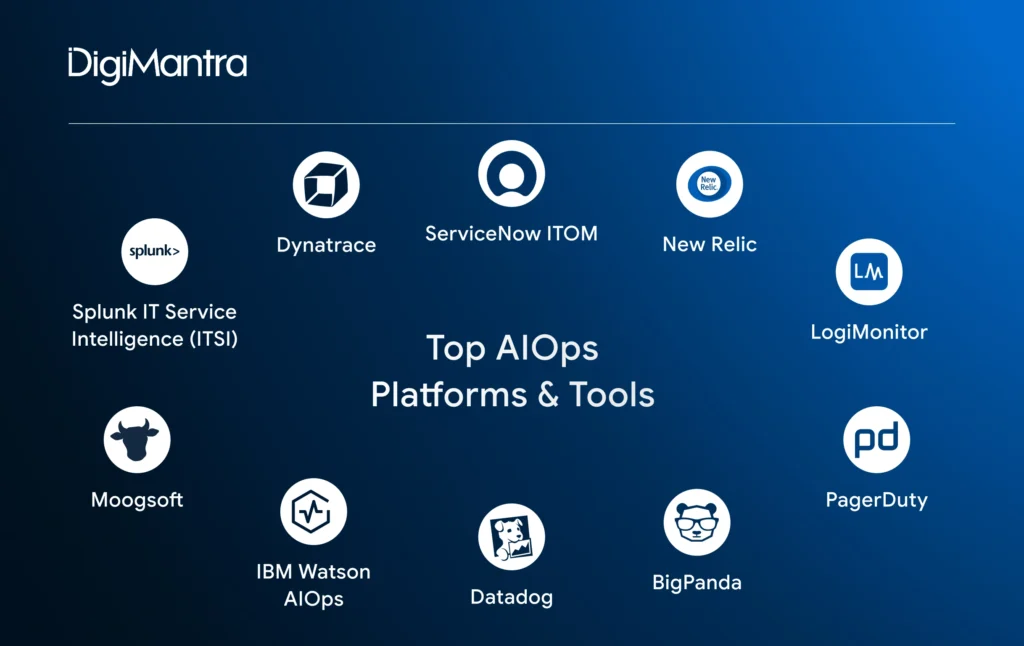
1. Dynatrace
Overview: Dynatrace is an AI-powered observability and security platform driven by its Davis® AI engine, designed to deliver deep visibility across modern IT ecosystems.
Key Capabilities:
- End-to-end visibility across applications, infrastructure, and digital experience.
- AI-led problem detection and automated root cause identification.
- Native support for cloud platforms, Kubernetes, and microservices.
Best Suited For: Large enterprises managing complex, cloud-first, or hybrid IT environments.
2. Splunk IT Service Intelligence (ITSI)
Overview: Splunk ITSI extends Splunk’s analytics capabilities to IT operations, using machine learning to provide service-level insights.
Key Capabilities:
- Intelligent event aggregation and service health monitoring.
- Predictive analytics to identify issues before escalation.
- Broad data ingestion for centralized operational visibility.
Best Suited For: Organizations that rely heavily on log data and need advanced incident analytics.
3. Moogsoft
Overview: Moogsoft is an AIOps-focused platform built to minimize alert noise and accelerate incident resolution.
Key Capabilities:
- AI-driven event correlation and pattern detection.
- Collaboration features to support cross-team workflows.
- Automated incident handling to reduce response time.
Best Suited For: IT teams looking to improve operational efficiency and team coordination.
4. IBM Watson AIOps
Overview: IBM Watson AIOps uses machine learning in DevOps to help enterprises automate and optimize IT operations at scale.
Key Capabilities:
- Intelligent event analysis and cause identification.
- Seamless integration with ITSM and enterprise tools.
- Predictive intelligence to support proactive operations.
Best Suited For: Enterprises seeking AI-enabled automation within established IT ecosystems.
5. Datadog
Overview: Datadog is a cloud-native monitoring and analytics platform built for modern, distributed applications.
Key Capabilities:
- Unified DevOps observability with AIOps across metrics, traces, and logs.
- AI-powered detection of abnormal system behavior.
- Extensive integrations across cloud and DevOps tools.
Best Suited For: Organizations operating cloud-scale and containerized environments.
6. BigPanda
Overview: BigPanda focuses on incident intelligence, helping teams connect alerts and manage incidents more effectively.
Key Capabilities:
- Intelligent alert grouping and noise reduction.
- Automated workflows for incident response.
- Easy integration with existing monitoring solutions.
Best Suited For: Teams aiming to reduce alert fatigue and improve operational responsiveness.
7. PagerDuty
Overview: PagerDuty is a digital operations platform that helps teams respond to incidents quickly and reliably.
Key Capabilities:
- Real-time alerting and automated incident workflows.
- Integration with a broad ecosystem of observability solutions.
- Analytics to improve operational performance over time.
Best Suited For: Organizations that prioritize fast, reliable incident response.
8. LogiMonitor
Overview: LogiMonitor is a cloud-based solution designed to monitor infrastructure performance and availability.
Key Capabilities:
- Automated asset discovery and monitoring.
- Custom dashboards and configurable alerting.
- Integration with ITSM and collaboration platforms.
Best Suited For: Teams needing centralized infrastructure monitoring with flexible reporting.
9. New Relic
Overview: New Relic provides real-time observability across applications and infrastructure to support performance optimization.
Key Capabilities:
- End-to-end visibility using metrics, traces, and logs.
- AI-assisted detection of unusual performance patterns.
- Broad cloud and DevOps integrations.
Best Suited For: Organizations focused on application performance and user experience.
10. ServiceNow IT Operations Management (ITOM)
Overview: ServiceNow ITOM offers a set of tools designed to automate and modernize IT operations within the ServiceNow ecosystem.
Key Capabilities:
- Event monitoring and intelligent correlation.
- Automated remediation and workflow orchestration.
- Tight integration with ServiceNow ITSM solutions.
Best Suited For: Enterprises looking to standardize and automate IT operations on a single platform.
Steps to Implement AIOps Successfully
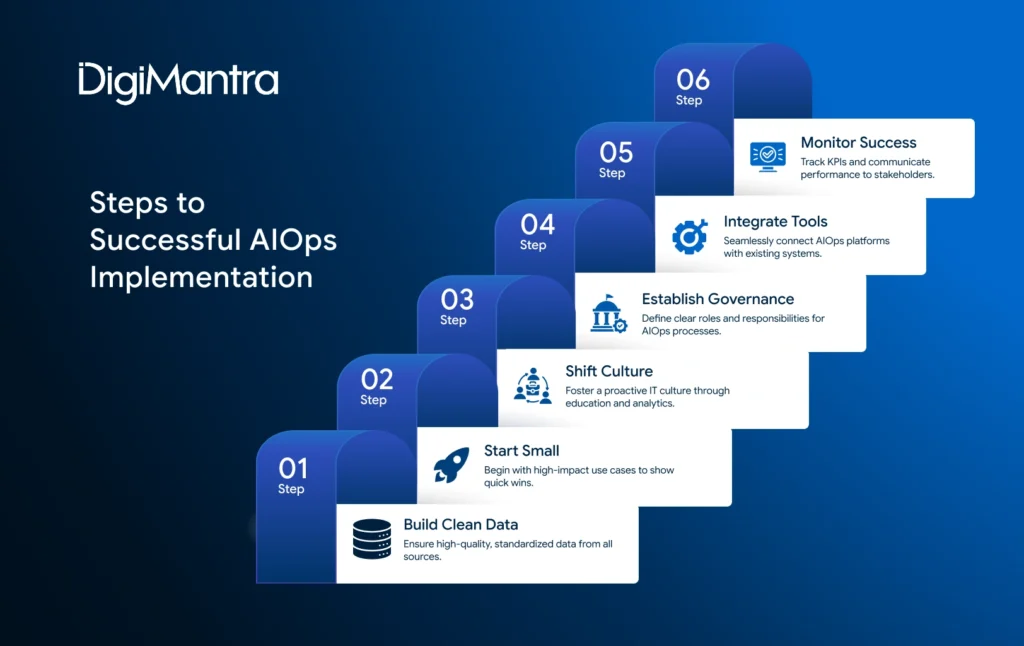
A structured rollout helps AIOps and Machine learning in DevOps deliver measurable results. These steps highlight how to implement it effectively across your IT operations.
Start with Clean Data and Strong Observability
- AI-driven DevOps is only as good as the data behind it. Make sure you’re collecting accurate, consistent data from logs, metrics, traces, and configuration sources across your IT stack.
- Clean things up using normalization, deduplication, and enrichment so your teams aren’t drowning in duplicate alerts or conflicting signals.
- Bringing everything into a centralized observability platform or data lake makes it much easier to see what’s happening end to end and connect the dots when issues arise.
Begin Small with High-Impact Use Cases
- Don’t attempt to tackle everything right from the start. Start with focused use cases like alert noise reduction or anomaly detection where AIOps can deliver quick, visible wins.
- Run a pilot on a critical service or a limited part of your infrastructure, then expand as confidence grows.
- Track metrics such as MTTR, false positives, and automation success rates to fine-tune your approach before scaling further.
Move from Firefighting to Proactive Operations
- DevOps automation with AI works best when teams stop reacting to problems and start preventing them. Encourage a shift toward predictive insights, automation, and data-driven decision-making.
- Use historical trends and root cause analysis to spot patterns and eliminate recurring issues instead of fixing the same problems repeatedly.
- Invest in training and upskilling so teams feel confident using AIOps tools and continuously improving how they work.
Set Clear Governance and Ownership
- Clarity matters. Define who owns the data, who has access, and who’s accountable for decisions and outcomes.
- Clearly assign responsibilities for monitoring, alert validation, incident response, and ongoing optimization to avoid confusion or duplicated effort.
Connect AIOps with Existing Tools and Workflows
- AIOps architecture shouldn’t sit in isolation. Integrate it with your ITSM platforms, DevOps tools, CI/CD pipelines, and security systems so insights flow directly into daily workflows.
- Automating ticket creation, routing, and collaboration helps teams respond faster while cutting down on manual work.
Track Results and Keep Improving
- Measure success using clear KPIs like mean time to detect (MTTD), mean time to resolve (MTTR), incident volume, and user experience.
- Use dashboards and reports to share progress with stakeholders, highlight improvements, and identify areas that need further optimization.
Conclusion: AIOps and the Future of DevOps
As artificial intelligence continues to advance, AIOps is emerging as a natural extension of modern DevOps practices. Rather than replacing existing DevOps tools or workflows, AIOps strengthens them – helping teams work faster, reduce manual effort, and focus on higher-value initiatives instead of repetitive operational tasks.
For organizations, the real conversation has shifted. It’s no longer about whether AIOps belongs in DevOps, but about how to introduce AI into everyday workflows in a practical and sustainable way. The most effective path forward is a gradual one: start with focused use cases, build confidence through measurable results, and expand adoption over time. By taking steady steps toward AI-enabled operations with the help of a reliable digital transformation company, DevOps teams can unlock long-term efficiency without disrupting what already works.
Looking to scale DevOps at the enterprise level? Reach out to the DigiMantra experts for DevOps consulting services.

AI-FIRST ENGINEERING FOR MODERN BUSINESSES
Designed for performance. Powered by innovation.
 Product Development
- Custom Software
 Mobile & Web
- AI & Automation
- Cloud Management
- Intelligent Systems