Key Takeaways
- Infrastructure as Code streamlines cloud provisioning through automation and consistency.
- Terraform and Pulumi are leading IaC tools with strong multi-cloud support.
- Terraform excels in stability, maturity, and enterprise use cases.
- Pulumi offers flexibility by using real programming languages.
- The best choice depends on your team’s skills and infrastructure needs.
Not long ago, building application infrastructure meant juggling multiple teams, including system admins, storage specialists, backup engineers, and developers, all working through manual processes that were slow, expensive, and prone to errors. Deployments dragged on, resources sat idle during low traffic, and even small mistakes could snowball into major outages.
The move to cloud platforms simplified much of this chaos, but speed, consistency, and scalability still fell short of modern expectations. That urgency sparked a new era in infrastructure management, known as Infrastructure as Code (IaC). According to MarketsandMarkets, the global Infrastructure as Code (IaC) market is projected to reach USD 2.3 billion with the approaching year 2027, expanding at a strong 24% CAGR between 2022 and 2027.
However, the growing number of IaC tools in the market is creating confusion for DevOps teams trying to choose the right fit. While some platforms are rapidly gaining traction, others are seeing declining adoption. In this landscape, Terraform and Pulumi stand out as two of the best Infrastructure as Code tools.
Terraform allows teams to deploy infrastructure across multiple cloud platforms, though it now operates under a BSL license. Pulumi, on the other hand, is open-source and lets developers manage cloud resources using familiar programming languages like Python and Go.
In this blog, we’ll dive into these IaC tools comparison and break down how they stack up.
What is IaC?
Infrastructure as Code (IaC) refers to managing, provisioning, and configuring IT infrastructure through machine-readable configuration files instead of manual setup or interactive tools, enabling efficient cloud infrastructure automation at scale. Using IaC, infrastructure environments can be deployed and maintained automatically and consistently based on predefined definitions. This approach makes IaC a core DevOps practice, as infrastructure is handled like application code and follows the same workflows, tools, and governance processes.
“Infrastructure as Code (IaC) enables you to provision and manage cloud resources using a declarative configuration language. It tracks infrastructure state, plans changes before applying them, and ensures consistent environments across development, staging, and production”, explains Sumit Kumar, Technical Head, Development at DigiMantra
Key Benefits of IaC Today Include:
- Treating infrastructure as code, enabling version control, peer reviews, and change tracking.
- Automating cloud infrastructure provisioning to reduce manual errors and accelerate deployment.
- Making it easy to reproduce environments reliably across teams and stages.
- Supporting a declarative model where you define the desired state and tools handle the execution accordingly.
A Look at Terraform
Terraform is a widely adopted open-source IaC platform and is often regarded as the industry standard for provisioning and managing cloud infrastructure due to its maturity and strong community support. It follows a declarative approach, where you define the target state of your infrastructure, and the engine compares it with the current state to determine which resources need to be created, modified, or removed. Terraform uses a simple, readable language called HashiCorp Configuration Language (HCL) to describe and manage infrastructure. All infrastructure definitions are written using HCL, and its declarative model eliminates the need for complex logic structures like loops, conditionals, or classes, making it beginner-friendly.
“Terraform simplifies multi-cloud deployments and makes infrastructure predictable, repeatable, and version-controlled”, highlights Sumit Kumar, Technical Head, Development at DigiMantra
Now, let’s explore the advantages and limitations of Terraform as an IaC tool.
The Pros of Terraform
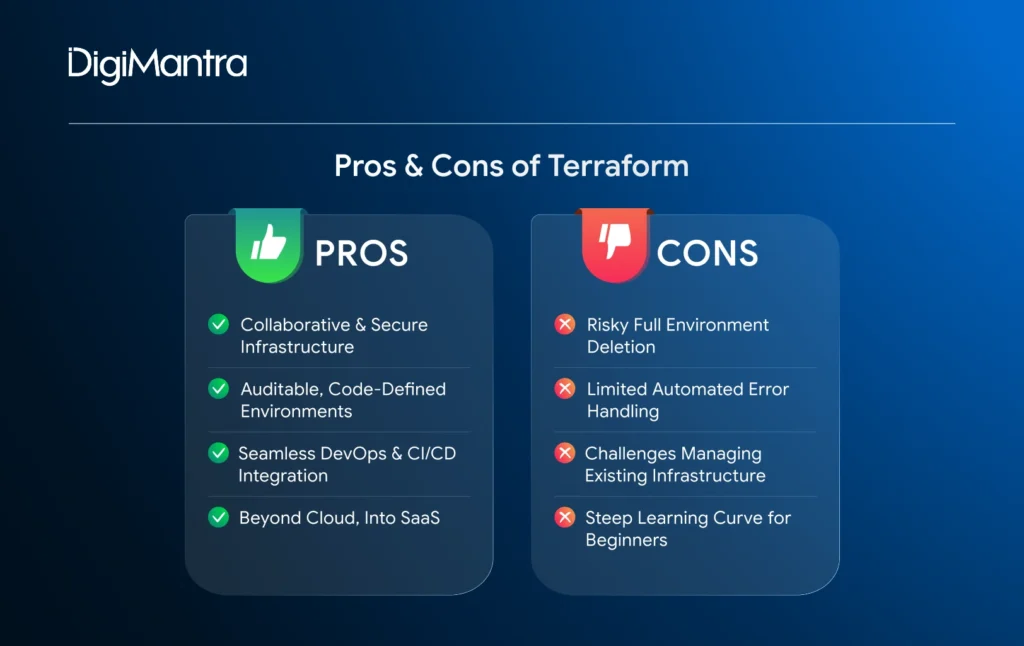
- Teams can collaborate efficiently using Terraform’s version-controlled registry, which also securely stores encrypted local variables such as credentials and API tokens.
- Since infrastructure is defined through code, you can easily audit and verify the current environment by reviewing the configuration files.
- Terraform integrates seamlessly with popular DevOps platforms like GitLab, allowing both application and infrastructure code to be managed within the same repositories and CI/CD pipelines.
- Beyond cloud resources, Terraform can also manage infrastructure for SaaS platforms such as Okta, Datadog, and more.
The Cons of Terraform
- Terraform allows full environment deletion using terraform destroy, which removes all deployed resources. If misused, this can cause serious issues, including disruptions to dependent systems or services.
- It lacks robust automated error handling, which can result in longer recovery times and increased manual intervention during deployment failures.
- Terraform has limited native support for importing existing resources into its state file, making it harder to manage infrastructure that wasn’t originally created with Terraform.
- Although HCL is widely adopted, it can be challenging for beginners to learn.
Understanding Pulumi
Pulumi is a modern DevOps Infrastructure as Code platform used to provision, deploy, and manage cloud infrastructure. While it follows a declarative model, it does not require learning a specialised configuration language. Instead, you define infrastructure using familiar general-purpose programming languages such as Python, TypeScript, JavaScript, Go, .NET, and Java.
For instance, when using Python, Pulumi works as a standard package, allowing you to write conditional logic, create classes, structure code blocks, and apply full software development services and practices. This developer-friendly approach has made Pulumi increasingly popular and fast-growing.
Let’s explore the advantages and drawbacks of the Pulumi IaC platform.
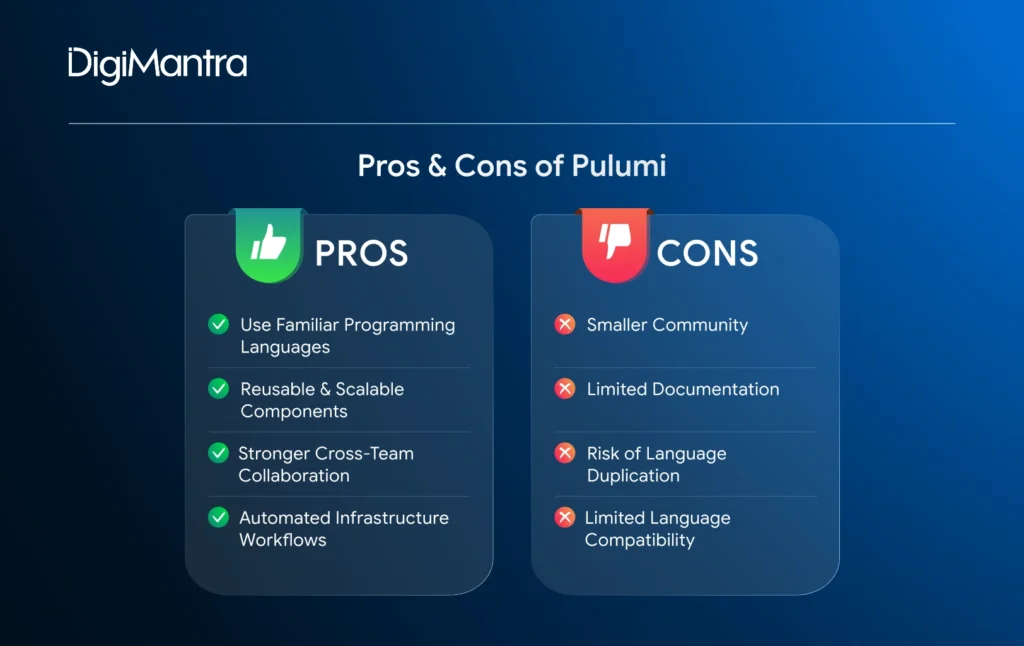
The Pros of Pulumi
- Pulumi lets you manage infrastructure using the programming languages you already know.
- Support for general-purpose languages makes it easy to create reusable infrastructure components and platforms efficiently.
- It promotes strong collaboration across development, security, and infrastructure teams through version control, role-based access controls, and multi-language support.
- Like Terraform, Pulumi automates infrastructure workflows, reducing manual effort and lowering operational costs.
The Cons of Pulumi
- A significant drawback of Pulumi is its limited documentation and smaller community, since it is still a relatively new tool.
- Using multiple programming languages can lead to duplication, with the same infrastructure being defined in different languages.
- Pulumi is not yet universally compatible, as it currently lacks support for certain popular languages like Ruby, PHP, and Swift.
Similarities Between Terraform and Pulumi
Explore how Terraform and Pulumi are similar in managing and deploying cloud infrastructure-
- Both Terraform and Pulumi support major cloud providers such as AWS, Azure, and Google Cloud, allowing you to provision and manage infrastructure across these platforms.
- Both tools are open-source, enabling free usage and the ability to customise the code to meet specific requirements.
- Functionally, Terraform and Pulumi are quite similar, as both can manage infrastructure in public clouds, on-premises environments, or hybrid setups.
- Both rely on a declarative approach, where you specify the desired state of your infrastructure, and the tool ensures it is provisioned and updated accordingly.
Side-by-Side Comparison: Terraform vs Pulumi
Explore a detailed Terraform and Pulumi comparison to understand how each tool approaches cloud infrastructure automation, scalability, and developer experience, helping you choose the right IaC solution for your cloud strategy.
|
Feature |
Pulumi |
Terraform |
| Language Support | Python, TypeScript, Go, C#, Java | HashiCorp Configuration Language (HCL) |
| Programming Paradigm | Imperative, leveraging full programming language features | Declarative, domain-specific language |
| State Management | Managed via cloud service or self-hosted, with encrypted secrets support | Local or remote state files; concurrency must be handled manually |
| Testing & Validation | Unit and integration testing using native languages | Basic validation; external tools like Terratest required for deeper testing |
| Developer Tooling | Full IDE support, debugging, and linting | Strong editor extensions available |
| Ecosystem Maturity | Rapidly growing, supports multi-language providers | Well-established with a large community and extensive modules |
| Security & Compliance | Policy as Code via Pulumi Policy Framework | Sentinel for policy enforcement; integrates with Vault for secrets |
| Licensing & Cost | Open-source core with optional commercial SaaS tiers | Open-source core; Enterprise and Cloud tiers are commercial |
| Performance & Scalability | Handles complex logic and programming constructs effectively | Proven for large-scale, multicloud deployments |
| Multi-cloud & Hybrid Cloud | Multi-cloud support within a single language | Wide provider ecosystem for hybrid cloud environments |
| CI/CD & DevOps Integration | Strong automation API; integrates with GitHub Actions, Jenkins | Deep CI/CD tool integration and workflow support |
| Learning Curve & Resources | Steeper for those new to programming; highly developer-friendly | Easier for operations teams; rich tutorials and community resources |
Real-World Use Cases and Decision Factors
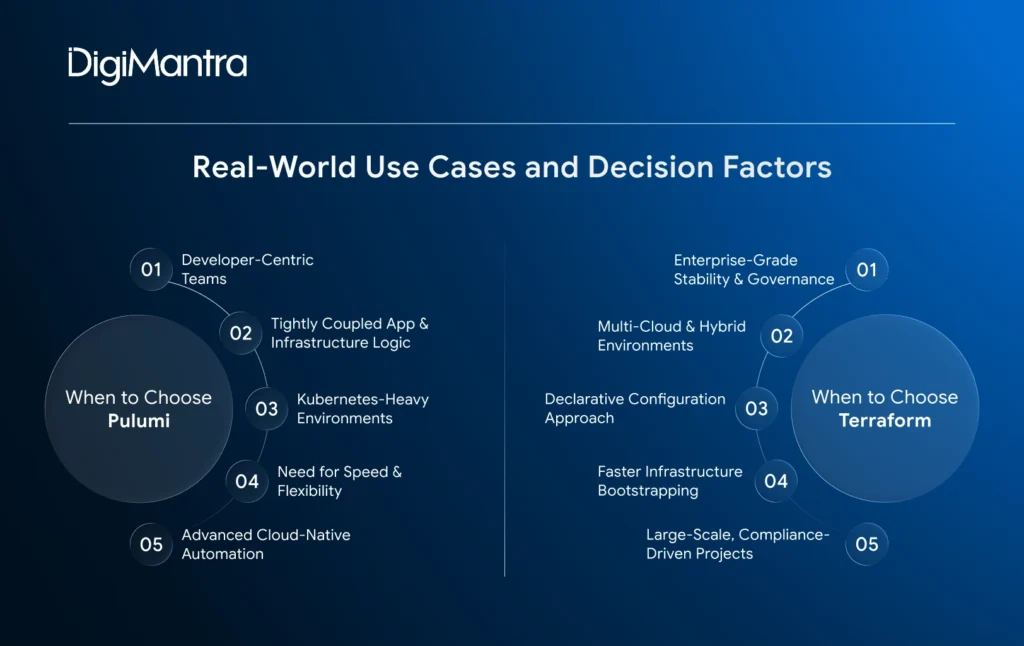
When to Choose Pulumi:
- Your team is developer-focused and skilled in languages like Python or Go.
- You need to integrate infrastructure logic closely with application code or manage complex workflows.
- Your environment relies heavily on Kubernetes, where native APIs and testing capabilities are essential.
- You require fast innovation and flexibility with support for dynamic providers.
- Pulumi is preferred for projects involving advanced Kubernetes clusters and cloud-native automation with custom logic.
When to Choose Terraform:
- You prioritise stability, a large community, broad provider support, and enterprise governance.
- You work across multi-cloud or hybrid environments and need a proven, reliable IaC solution.
- Your team prefers a declarative approach and has strong DevOps and infrastructure expertise.
- Terraform’s mature modules help accelerate infrastructure bootstrapping.
- Terraform is used for large-scale multi-cloud provisioning projects where predictable, con
Factors to Consider When Choosing Between Pulumi and Terraform
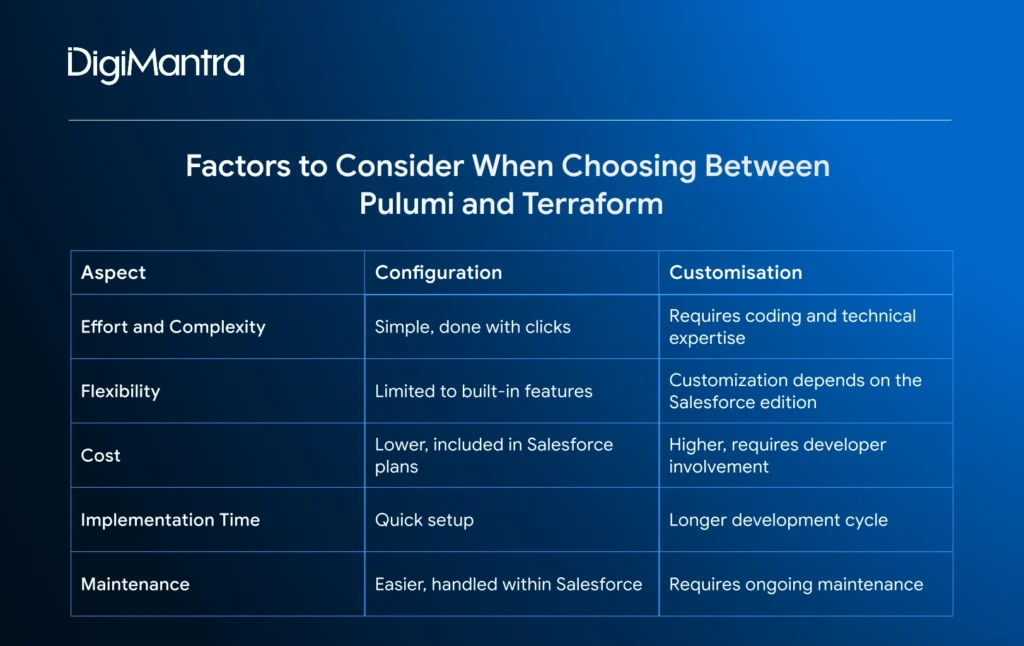
When selecting an IaC tool, it’s important to evaluate several factors to determine whether Pulumi or Terraform best aligns with your team’s skills and project requirements.
Team Expertise and Language Familiarity
- Pulumi is ideal if your team is experienced in general-purpose programming languages like JavaScript, TypeScript, Python, Go, or .NET. It allows infrastructure to be defined using familiar languages, reducing the learning curve and leveraging existing development skills.
- Terraform is suited for teams that prefer a declarative approach. Its HashiCorp Configuration Language (HCL) is simple, readable, and easy to learn, making it accessible even for those new to IaC.
Project Complexity and Requirements
- Pulumi works well for complex scenarios where flexible programming logic is needed. It’s especially useful when infrastructure management involves conditional configurations, intricate workflows, or tight integration with application code.
- Terraform is a strong choice for straightforward infrastructure tasks and multi-cloud deployments. Its declarative style simplifies infrastructure definitions, making them easier to maintain and understand.
Integration and Ecosystem Needs
- Pulumi integrates smoothly with development tools and workflows, supporting many DevOps tools like Ansible, Chef, and existing Terraform providers. Its flexibility can be a major advantage if you need seamless integration with existing systems.
- Terraform benefits from a mature ecosystem and community support, offering numerous pre-built modules and providers. Its stability and adoption provide abundant resources, tutorials, and third-party integrations.
Community Support
- Pulumi, being newer, has a growing but smaller community. While it has gained traction and improved its documentation, resources may still be limited compared to Terraform.
- Terraform has a long-established, active community, extensive tutorials, and a wide range of community-developed modules. Its maturity ensures reliable support and comprehensive documentation.
Cost and Licensing Considerations
- Pulumi is open source, but advanced features and enterprise solutions are paid. Assess the licensing and potential costs if premium functionality is required.
- Terraform is also open source, with Terraform Cloud and Terraform Enterprise offering additional collaboration and governance features for a fee. Consider these costs if you need advanced enterprise capabilities.
Which Tool is Better: Terraform or Pulumi?
During this IaC tools comparison, both Terraform and Pulumi offer distinct strengths and trade-offs. Terraform is a well-established tool with a mature ecosystem and a broad range of available resources. On the other hand, Pulumi has gained popularity for its ease of use, growing documentation, and active community, continuously enhancing the platform.
For the best Infrastructure as Code tool, the choice ultimately depends on your requirements. If stability, a rich knowledge base, and extensive resource availability are priorities, Terraform is often the preferred option. Conversely, if you value usability, flexibility, and a rapidly evolving toolset, Pulumi may better suit your needs.
Take your infrastructure management to the next level with intelligently curated Infrastructure as Code services. Schedule a demo with DigiMantra experts today to see how we help organisations innovate and deliver exceptional employee and customer experiences.

AI-FIRST ENGINEERING FOR MODERN BUSINESSES
Designed for performance. Powered by innovation.
 Product Development
- Custom Software
 Mobile & Web
- AI & Automation
- Cloud Management
- Intelligent Systems