





Artificial Intelligence is powering everything, from personalised recommendations to real-time decision-making systems. But as AI grows smarter, it’s also becoming heavier, requiring vast computational resources, massive datasets, and always-on infrastructure.
What often gets overlooked is this: intelligence at scale comes with an environmental cost.
Training a single large AI model can consume enormous energy. In fact, research by Gitnux highlights that training a model like GPT-3 generated over 500 tons of CO₂ emissions, putting into perspective how resource-intensive modern AI has become.
This is exactly why Green AI is gaining momentum, but as a necessary shift in how we design and deploy intelligent systems.
What is Green AI, and Why It’s Different
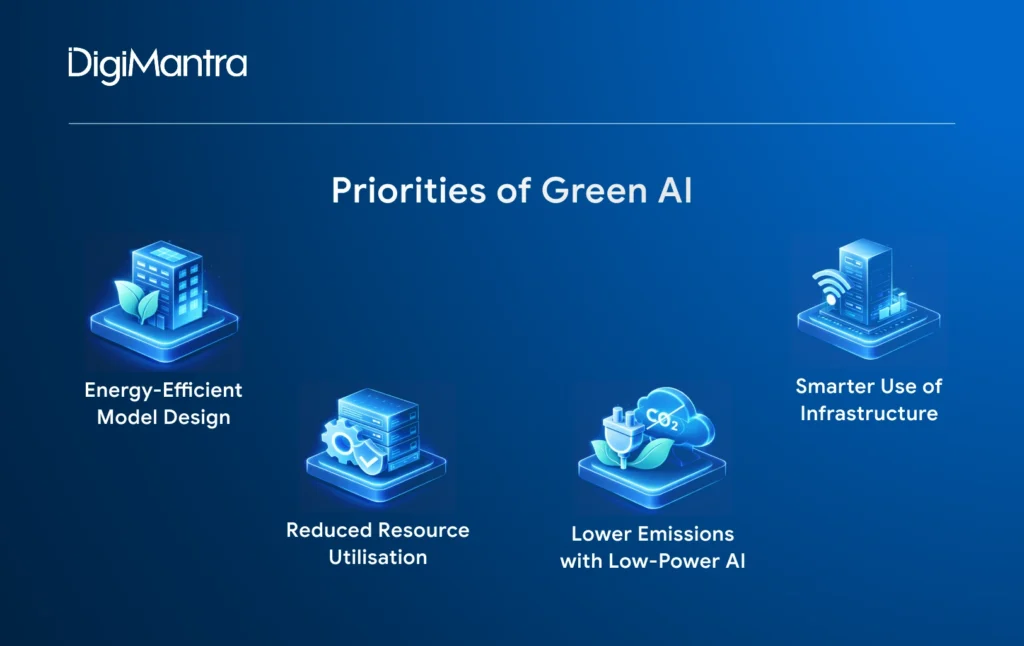
Green AI is about building sustainable AI systems and advancing Generative AI Development Services that balance performance with efficiency. It challenges the long-standing mindset of “bigger models = better results” and replaces it with a more responsible approach: “better outcomes with fewer resources.”
Instead of focusing purely on accuracy benchmarks, Green AI prioritises:
- Energy-efficient model design.
- Reduced computational overhead.
- Lower emissions with low-power AI models
- Smarter use of infrastructure.
This shift is not just technical, but it’s philosophical. It redefines success in AI from how powerful a model is to how efficiently it delivers value.
Why Green AI is Becoming a Business Imperative
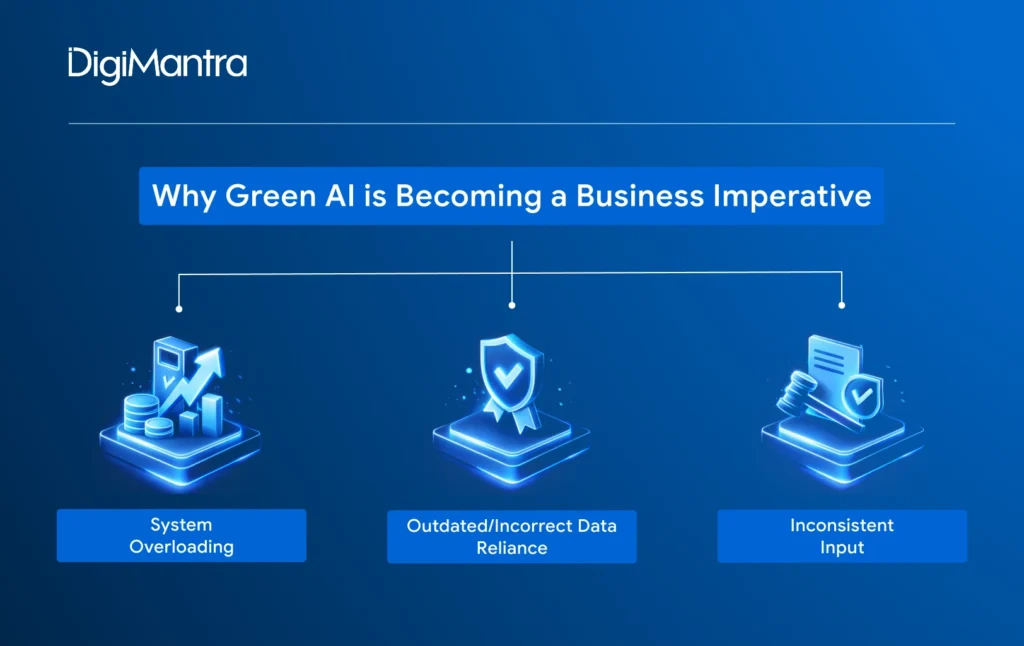
For businesses investing in AI, sustainability is no longer a side consideration. It directly impacts performance, cost, and scalability.
Rising Energy Demand is Hitting the Bottom Line
AI systems don’t just run once; they operate continuously. From recommendation engines to chatbots, inference (real-time predictions) consumes energy every second.
According to industry insights from Great Report, up to 70% of an AI system’s total energy usage happens during inference, not training. This means inefficient models quietly drive long-term operational costs.
Sustainability is Now a Brand Differentiator
Customers and stakeholders are becoming more conscious of how technology impacts the planet. Businesses that adopt eco-friendly AI development practices are better positioned to build trust and long-term credibility.
Regulation is Catching Up
With governments pushing for carbon reduction goals, companies using high-energy AI systems may soon face stricter compliance requirements. Green AI helps future-proof your technology investments.
Core Principles Behind Energy-Efficient AI Models
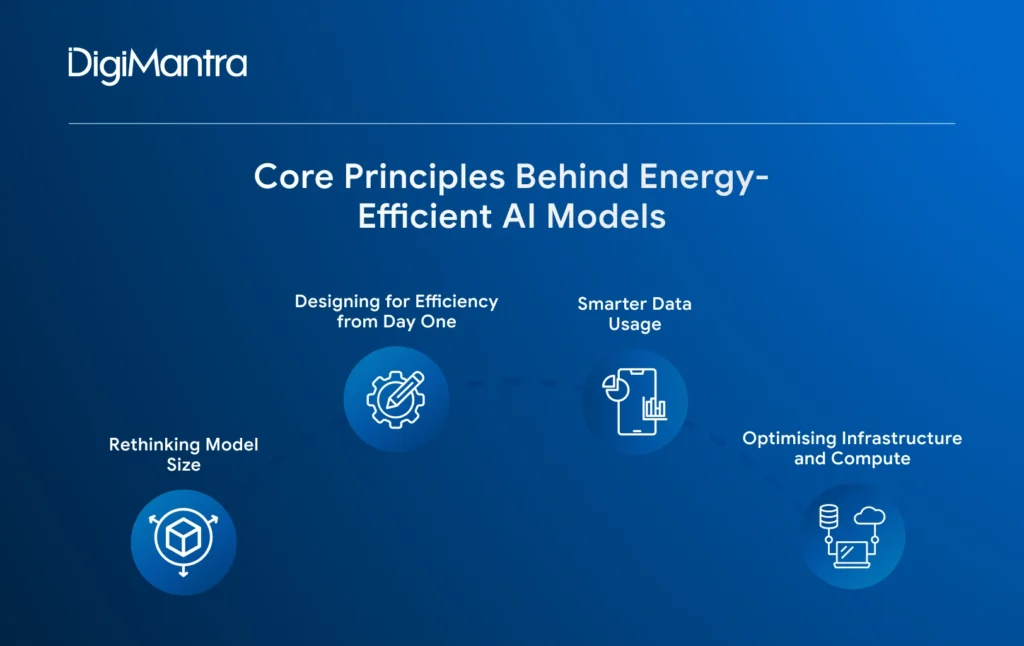
Green AI isn’t achieved through one change. It’s the result of multiple optimisations across the AI lifecycle.
1. Rethinking Model Size
The industry is shifting away from unnecessarily large models toward lean, purpose-built architectures. A well-optimised smaller model can often deliver comparable results with a fraction of the energy.
2. Designing for Efficiency from Day One
Energy efficiency in AI shouldn’t be an afterthought; it begins at the design stage. Choosing the right algorithms, avoiding redundant computations, and structuring models for optimal performance are all key strategies. By embedding efficiency into the model from the start, sustainability becomes a core part of the system rather than something added later.
3. Smarter Data Usage
More data doesn’t always lead to better AI outcomes. Processing irrelevant or duplicate information can increase energy consumption without improving model performance. Efficient AI systems prioritise high-quality datasets, maintain clean and streamlined data pipelines, and focus on targeted training processes that maximise impact while minimising energy use.
4. Optimising Infrastructure and Compute
The infrastructure behind AI, such as servers, GPUs, and data centres, can quickly become the largest contributor to energy consumption. In fact, global AI-driven systems used roughly 415 terawatt-hours of electricity in 2024, a figure comparable to the annual energy use of some mid-sized countries, according to All About AI.
This makes infrastructure choices critical, with businesses needing to invest in energy-efficient hardware, leverage renewable-powered data centres, and adopt cloud environments optimised for sustainability.
Practical Strategies to Build Green AI Systems
Moving from concept to implementation requires actionable strategies. Here’s how organisations can start:
Model Compression Techniques
Reducing model size without sacrificing performance is one of the most effective ways to cut energy usage.
Pruning: Removing unnecessary parameters.
Quantisation: Lowering precision to reduce compute load.
Knowledge distillation: Training smaller models from larger ones.
Efficient Model Architectures
Modern architectures are being designed to maximise output while minimising computation. These models are particularly useful for real-time applications and edge devices.
Optimising the Inference Layer
Since inference consumes the majority of energy, optimising deployment is critical:
- Use batch processing where possible.
- Reduce latency through efficient serving systems.
- Deploy regionally to minimise data transfer.
Adopting Green Cloud Practices
Cloud providers now offer tools to monitor and reduce carbon impact. Leveraging green computing can significantly improve sustainability without compromising scalability.
Hardware-Level Optimisation
Specialised chips such as TPUs and energy-efficient GPUs are designed to deliver higher performance per watt, making them essential for sustainable AI systems.
The Bigger Picture: AI and Climate Responsibility
AI is not just contributing to environmental challenges; it also has the potential to solve them.
But this creates a paradox: How can we use AI to fight climate change if AI itself is energy-intensive?
The answer lies in responsible innovation.
Data centres, which power AI workloads, already contribute around 2% of global greenhouse gas emissions, according to Gitnux. Without intervention, this number is expected to rise as AI adoption accelerates.
Green AI helps break this cycle by ensuring that technological progress does not come at the cost of environmental stability.
Challenges in Adopting Green AI
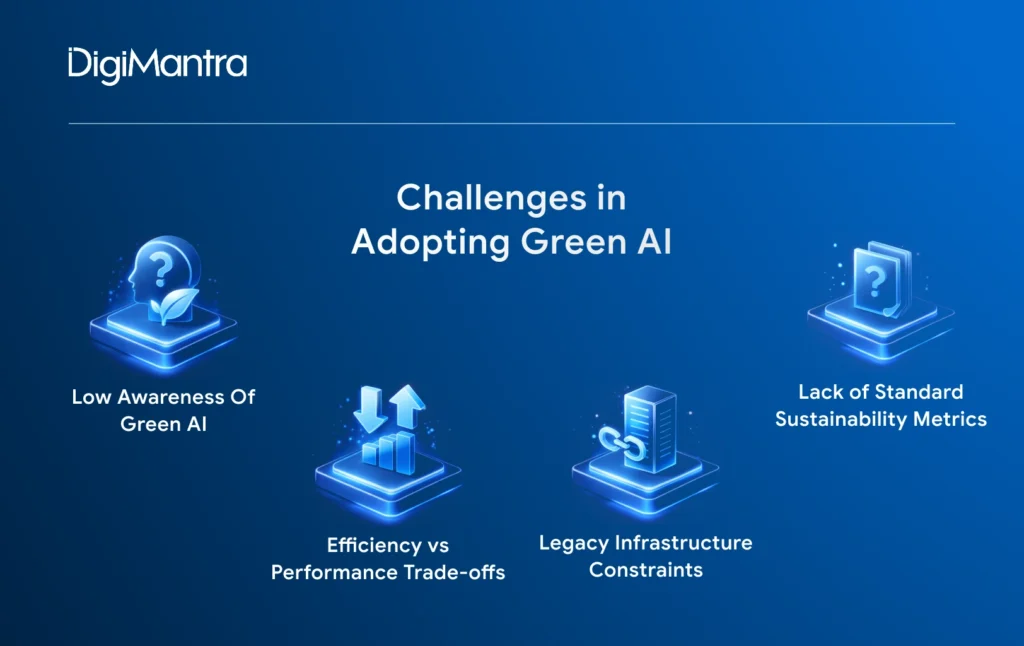
Transitioning to Green AI offers many benefits, but organisations often face real-world hurdles that slow adoption. These challenges highlight the complexity of balancing performance with sustainability:
Limited awareness among organisations – Many companies are still unfamiliar with the concept of Green AI or the practical strategies to implement it effectively, making adoption slower than ideal.
Trade-offs between efficiency and peak performance – Optimising for energy efficiency can sometimes seem at odds with achieving maximum computational performance, requiring careful design decisions.
Dependence on existing infrastructure – Legacy systems and conventional data centres may not support energy-efficient models, forcing companies to adapt or invest in upgrades.
Lack of standardised sustainability metrics – Without universally accepted metrics, measuring and benchmarking the environmental impact of AI models remains challenging, creating uncertainty for decision-makers.
Despite these obstacles, progress is rapid. As awareness grows and new tools and frameworks emerge, Green AI is set to become the standard rather than the exception.
What the Future of Green AI Looks Like
The next generation of AI will be defined not only by intelligence but also by responsibility and efficiency. Early innovations already signal a shift towards greener practices:
Carbon-aware computing systems – Platforms are starting to schedule computations and workloads based on energy availability, minimising carbon footprint without sacrificing performance.
AI models designed for edge devices – Lightweight models running closer to end-users reduce the need for energy-intensive cloud processing, making AI more efficient and scalable.
Transparent reporting of AI energy consumption – Organisations are increasingly tracking and publishing the energy use of AI workflows, fostering accountability and sustainable decision-making.
Increased investment in sustainable AI research – More funding and attention are being directed toward developing algorithms and infrastructure that prioritise environmental impact alongside functionality.
Businesses that embrace these trends will not only lower costs but also gain a competitive edge in a market where sustainability matters to customers and stakeholders alike.
How DigiMantra Builds Sustainable AI Solutions
At DigiMantra, we believe innovation should scale responsibly. Our AI solutions are designed to balance high performance with minimal environmental impact:
Building energy-efficient, scalable AI models – Every model is architected to deliver top results while reducing energy usage across both training and inference.
Reducing unnecessary computational overhead – By optimising algorithms and eliminating redundant processes, we cut down wasted energy without compromising outcomes.
Designing systems optimised for long-term performance – Our solutions are built to maintain efficiency as usage scales, ensuring sustainability is embedded in the lifecycle.
Leveraging infrastructure that aligns with sustainability goals – From cloud platforms to on-premise deployments, we prioritise energy-efficient hardware and renewable-powered systems.
Whether it’s intelligent automation, predictive analytics, or full AI-powered platforms, every solution we build is crafted to be both high-performing and environmentally responsible.
Conclusion
The future of AI isn’t just about building more powerful systems. It’s about responsible and sustainable innovation. Green AI represents a shift in mindset, from maximising output at any cost to delivering value efficiently and ethically.
Energy-efficient AI models help reduce operational costs, lowering electricity and infrastructure expenses over time. They also improve scalability, allowing models to grow without dramatically increasing energy use or environmental impact.
By prioritising sustainability, companies can strengthen brand credibility, gaining trust with clients, partners, and the public. At the same time, adopting Green AI helps organisations contribute to global sustainability goals and reduce their overall carbon footprint.
Ultimately, the AI systems of the future won’t just be intelligent, but they’ll be efficient, ethical, and sustainable by design.
For expert guidance on building sustainable and energy-efficient AI models, reach out to the DigiMantra team today.

AI-FIRST ENGINEERING FOR MODERN BUSINESSES
Designed for performance. Powered by innovation.
 Product Development
- Custom Software
 Mobile & Web
- AI & Automation
- Cloud Management
- Intelligent Systems