


Everyone wants to build with AI. The ideas are brilliant, the potential is enormous, and then the cloud bill arrives. If you have ever watched your inference costs spiral out of control, or shelved an AI feature because the compute simply was not affordable, you are not alone.
The truth is, building AI products without a cost strategy is a bit like leaving the tap running while searching for a plumber. The problem is not AI itself. It is the absence of what the industry is increasingly calling AI cost engineering.
AI cost engineering is the deliberate practice of designing, developing, and scaling AI systems with financial efficiency baked in from day one.
This guide takes you through exactly how to do that. No jargon soup, no vague platitudes, just practical strategies you can apply whether you are a startup founder or a product manager at a scaling enterprise.
What Is AI Cost Engineering and Why Does It Matter Now?
AI cost engineering is the discipline of making deliberate architectural, tooling, and operational choices that reduce the total expenditure of building and running AI-powered products, without sacrificing quality or user experience.
In 2026, this has become more critical than ever. Generative AI adoption has accelerated sharply, and with it, the compute bills. AI projects are notoriously difficult to budget as the Gitnux Research suggests average cost overruns can reach around 40%, while poor cost visibility and unclear value continue to derail many initiatives.
If you are not measuring cost per inference, you are not engineering. You are hoping.
Meanwhile, CFOs and venture capitalists are demanding proof of return on AI investment. The era of funding AI experimentation indefinitely is over. Efficient growth, meaning scaling without incurring unrecoverable losses, is now a boardroom priority.
The good news? Between smarter model selection, leaner prompt design, and better infrastructure choices, there is a significant amount of headroom to claw back.
Understand Where Your AI Money Actually Goes
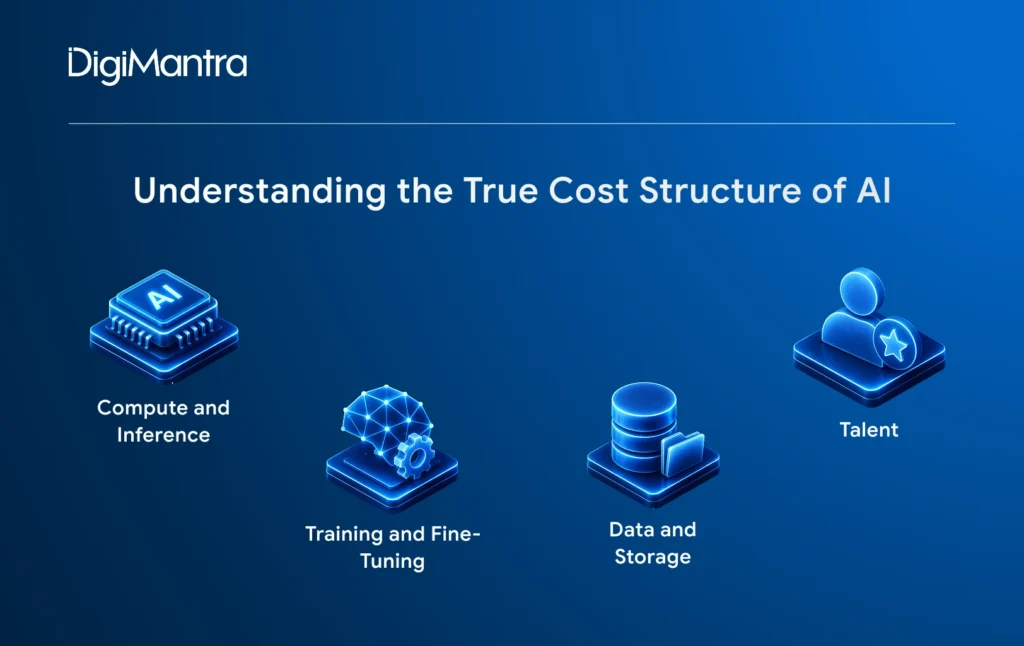
Before you can engineer costs down, you need to understand where they come from. AI expenditure typically falls into four buckets.
Compute and Inference
This is usually the largest ongoing cost. Every time your product calls a large language model (LLM), whether to summarise text, generate a response, or process data, you are consuming tokens, which translates directly to spend.
Training and Fine-Tuning
Training frontier models from scratch is brutally expensive and reserved for the likes of Google and Meta. But even fine-tuning a pre-trained model to suit your domain requires GPU-hours, which are not cheap. The silver lining is that for most businesses, fine-tuning is entirely optional and increasingly unnecessary.
Data and Storage
Preparing, cleaning, and storing training or retrieval data carries its own cost. Vector databases, embedding storage, and document preprocessing all add up, particularly at scale.
Talent
AI and ML engineers remain expensive and scarce. Senior AI engineer salaries can exceed £120,000 per year in the UK, and the average time-to-hire for ML roles runs well above 60 days. This overhead often dwarfs the raw compute cost for smaller teams.
Choose the Right Model for the Right Job
One of the most common and most costly mistakes in AI ML development services is defaulting to the most powerful model available for every task. It is understandable: you want the best output. But it is a bit like hiring a surgeon to apply a plaster.
Modern AI providers offer a spectrum of models at dramatically different price points. Token processing costs have fallen from roughly $12 per million tokens in 2022 to well under $2 for comparable performance in 2025, but only if you select the right tier.
The layered model approach:
A practical strategy is to route tasks by complexity:
- For simple classification, tagging, or short summarisation, use a lightweight, cost-efficient model.
- For moderate reasoning and multi-step analysis, use a mid-tier model.
- For complex generation, nuanced reasoning, and creative tasks, reserve the frontier model.
One financial analytics firm, as described in a 2025 case study, reduced its LLM API costs by 20% within six months simply by auditing which tasks truly required their most expensive model and rerouting the rest.
The largest or most advanced model is not always necessary for every application. Selecting the right model for your use case is one of the highest-leverage cost decisions you will make.
Master Prompt Engineering for Cost, Not Just Quality
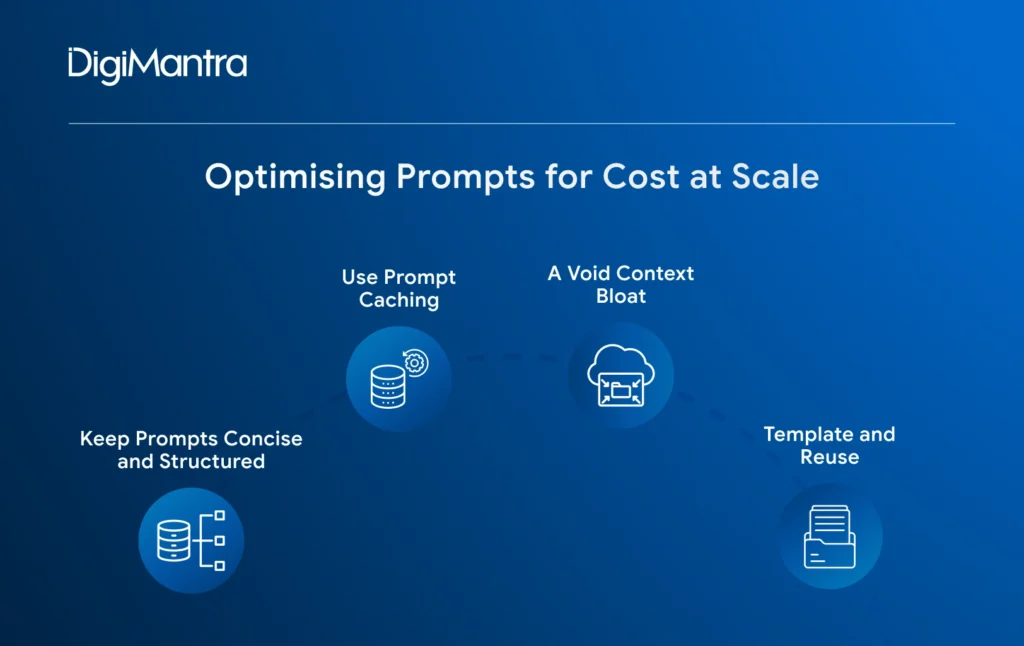
Prompts are not just instructions for your AI. They are the primary driver of token consumption and therefore cost. Prompt engineering for cost efficiency is a distinct and underrated skill.
Keep prompts concise and structured
Verbose, repetitive prompts burn tokens without improving output. Replacing wordy instructions with structured formats such as JSON can reduce token usage by around 15%, according to industry benchmarks. That might sound modest, but at scale, across millions of daily calls, it becomes a meaningful saving.
Use prompt caching
If your system prompt (the boilerplate instructions you send with every request) is static or near-static, caching it can slash input token costs dramatically. AWS Bedrock, for instance, offers a built-in prompt caching feature that reduces both latency and cost for repeated invocations.
Avoid context bloat
Context length costs scale quadratically. A 128,000-token context window costs 64 times more than an 8,000-token window for the same model. Be ruthless about what you actually include in context. Retrieval-augmented generation (RAG) is often far cheaper than stuffing an entire document into every prompt.
Template and reuse
Create reusable prompt templates for common tasks. Standardised, well-tested templates reduce both token usage and the engineering time spent debugging unpredictable outputs.
Start Small: The MVP and PoC First Principle
One of the most reliable ways to avoid budget burnout is to not build the full system first. A proof of concept (PoC) can cost as little as £8,000 to £24,000 and will answer the most critical questions: Does this approach work? Is the accuracy good enough? Will users actually engage with it? Think about all before you commit significant capital.
The MVP-first mindset is especially important in AI because the cost profile of a system often only becomes clear under real load. Building a minimum viable product lets you validate assumptions, identify the most expensive bottlenecks, and then optimise with actual data rather than theoretical estimates.
This is what separates teams that scale efficiently from those that build something expensive and then discover it does not convert.
Embrace Open-Source and Pre-Trained Models
There is a common misconception that serious AI products require proprietary models from OpenAI, Anthropic, or Google. That is no longer true for a wide range of use cases.
The open-source AI ecosystem has matured significantly. Models like Meta’s Llama family and various domain-tuned mid-size models now offer strong performance at a fraction of the inference cost of frontier models. For example, THUDM/GLM-4-9B-0414 costs approximately $0.086 per million tokens, a remarkable figure compared to GPT-4-class pricing even a year ago.
For teams with the infrastructure capability to self-host, open-source models can eliminate ongoing API fees entirely. The trade-off is engineering overhead, but for high-volume applications, the economics often tip decisively in favour of self-hosting.
Pre-built APIs from cloud providers also deserve consideration. Google Cloud, AWS Bedrock, and Azure OpenAI all offer managed inference with pay-as-you-go pricing, managed scaling, and minimal DevOps burden, which can be far more cost-effective for early-stage teams than running their own model infrastructure.
Optimise Your Inference Pipeline
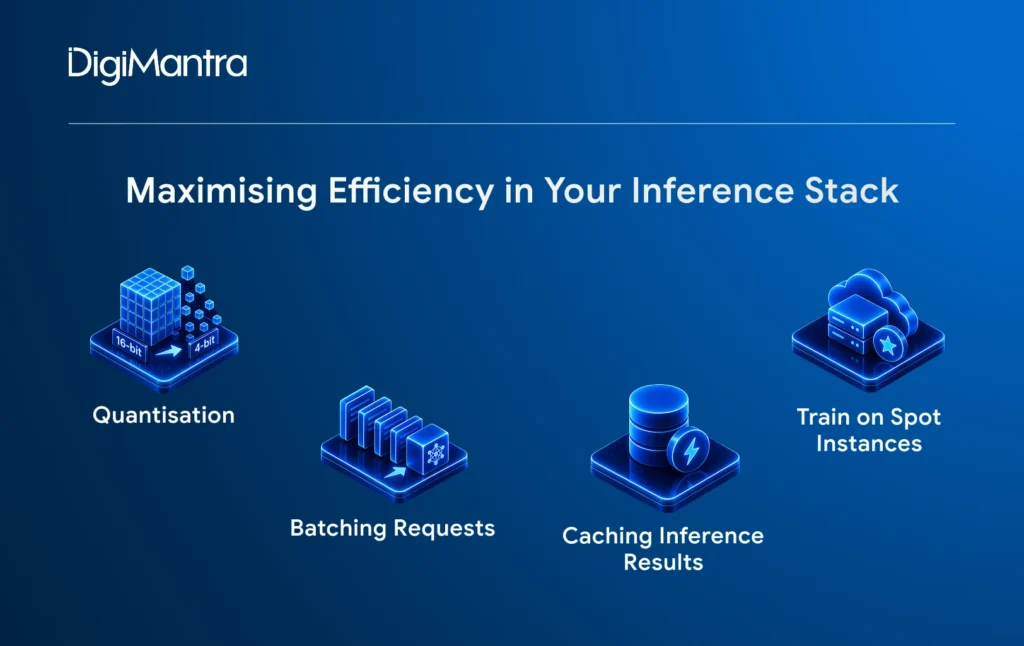
Once you have chosen your model and shaped your prompts, the next lever is how efficiently you run inference. Several techniques can meaningfully reduce cost without compromising output quality.
Quantisation
Quantisation compresses a model’s numerical precision (for example, from 16-bit to 8-bit or 4-bit), reducing memory requirements and speeding up inference. GPTQ quantisation at 4-bit can achieve a 75% cost reduction while maintaining roughly 99.5% of the model’s accuracy. It is one of the highest-leverage optimisations available and requires no retraining.
Batching requests
Rather than processing each user request individually, batching groups multiple requests together and runs them through the model simultaneously. Batching 32 requests at once can reduce per-token costs by up to 85%, with only a modest increase in latency, an acceptable trade-off for most non-real-time use cases.
Caching inference results
If the same or similar queries are frequent, caching their outputs avoids redundant model calls entirely. This is especially powerful in customer-facing chatbots where common questions repeat across users.
Use spot or preemptible instances for training
If you do need to run training or fine-tuning jobs, doing so on spot instances (cheaper, non-guaranteed cloud compute) rather than on-demand instances can cut those specific costs dramatically. Training workloads are naturally interruptible and well-suited to this approach.
Build Cost Telemetry into Your Stack from Day One
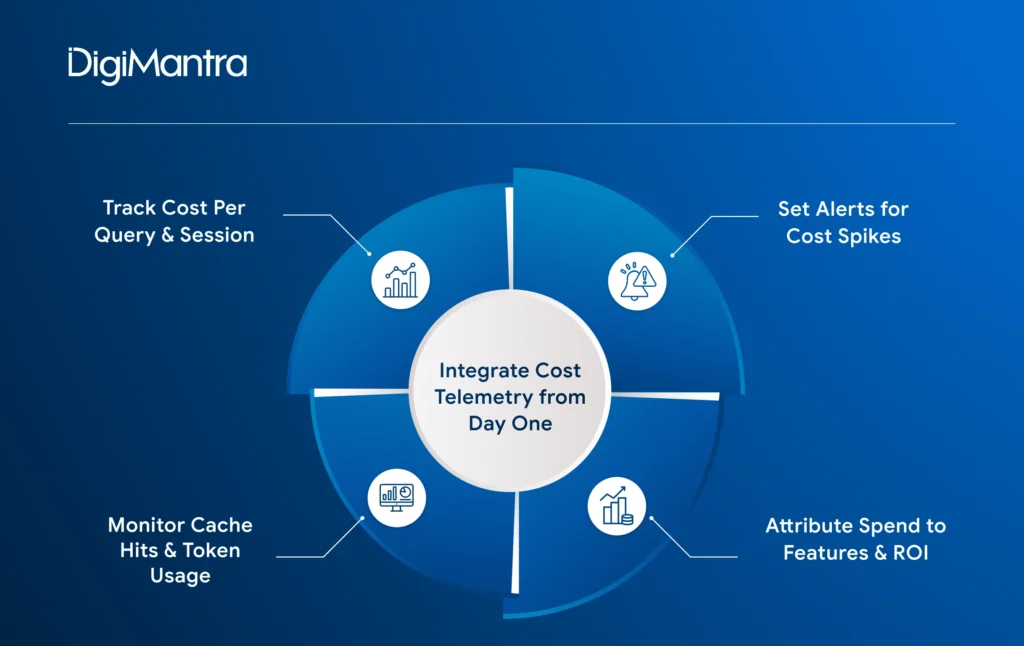
You cannot optimise what you cannot see. A significant cause of AI budget overruns is the absence of proper cost visibility. Teams discover they have overspent only when the invoice lands.
AI FinOps, the application of financial operations principles to AI infrastructure, is an emerging discipline that addresses this directly. The core idea is to instrument every layer of your AI stack so that spend is attributed to specific features, users, models, and use cases in real time.
Practically, this means:
- Tracking cost per query and cost per user session.
- Monitoring cache hit rates and token consumption per feature.
- Setting automated alerts when costs spike beyond expected thresholds.
- Attributing AI spend to specific product areas so you can calculate ROI per investment.
Tools like CloudZero, Datadog, and custom OpenTelemetry instrumentation can provide this visibility. The teams that scale AI profitably are almost always the ones that treat inference cost as a first-class engineering metric, not an afterthought.
Build an Agile, Iterative Development Culture
Cost efficiency in AI is not a one-time configuration. It is a culture. Teams that iterate rapidly, measure constantly, and prune ruthlessly tend to build far more cost-efficient systems than those that design comprehensively upfront and then build in a single pass.
Agile development promotes iterative work and quick feedback loops. In an AI context, this means shipping the simplest version of a feature that works, measuring its actual cost and performance in production, and then optimising based on real data. It also means killing features that do not perform, which is far easier to do when you have built a lean, modular system rather than an expensive monolith.
Outsourcing non-core tasks is another lever. Not every part of an AI pipeline needs to be built in-house. Data preprocessing, evaluation, and infrastructure management are all areas where third-party partners can deliver significant cost savings versus hiring dedicated internal specialists.
Measure ROI and Connect AI Spend to Business Outcomes
Ultimately, AI cost engineering is not just about spending less. It is about spending wisely. The goal is to maximise the return on every pound invested in AI capability.
Research from Stanford HAI 2025 AI Index Report confirms that businesses adopting AI in service operations register meaningful cost savings, with nearly half (49%) reporting reductions in those areas. On the revenue side, 71% of companies using AI in marketing and sales report gains. But these returns only materialise when AI investment is connected to clear business outcomes.
Define your success metrics before you build. Cost per successful interaction, reduction in support handle time, revenue influenced per AI-powered recommendation: whatever the metric, establish it early and track it relentlessly. When you can demonstrate that your AI feature generates £5 of value for every £1 of compute spend, the conversation about AI budgets becomes very different.
Frame the training spend like a capital investment, and not an operational expense. Distribute the cost over the model’s operational life. Focus optimisation cycles on the recurring inference bill, which compounds every day.
Quick Reference: AI Cost Engineering Checklist
- Start with a PoC or MVP to validate before scaling investment.
- Choose the lightest model that meets your accuracy and latency requirements.
- Optimise prompts for brevity and structure, and use caching for static system prompts.
- Implement quantisation and batching for inference cost reduction.
- Explore open-source alternatives before committing to proprietary API pricing.
- Instrument your stack with cost telemetry and per-feature spend attribution.
- Set automated cost alerts before bills surprise you.
- Build iteratively: measure real production costs and optimise from data.
- Define ROI metrics before building and connect spend to business outcomes.
- Revisit model selection regularly, as the market moves fast and pricing shifts quickly.
Final Thoughts
Building AI products without burning budget is not about cutting corners. It is about making deliberate choices. The companies that will win with AI are not necessarily those with the biggest compute spend. They are the ones that extract the most value from every token, every GPU cycle, and every pound invested.
AI cost engineering is what turns a fascinating experiment into a sustainable product. Start with the smallest version that works, instrument it rigorously, and let real-world data drive your optimisation decisions. The budget you save can fund the next feature, the next model, or the next market.
That is not frugality. That is engineering.

AI-FIRST ENGINEERING FOR MODERN BUSINESSES
Designed for performance. Powered by innovation.
 Product Development
- Custom Software
 Mobile & Web
- AI & Automation
- Cloud Management
- Intelligent Systems