


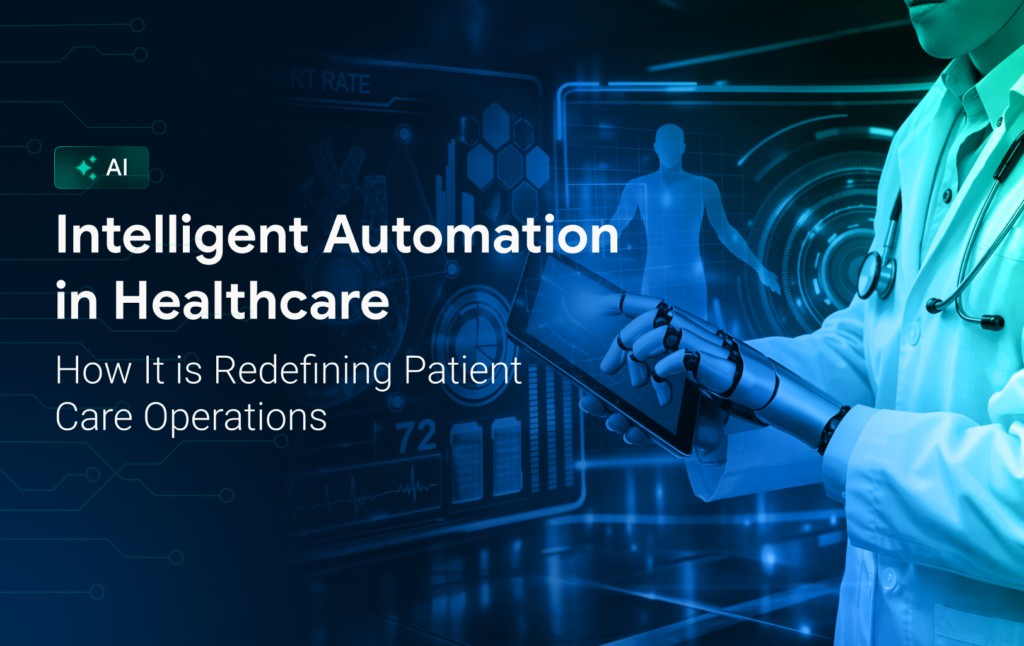
The future of healthcare isn’t about turning people into robots, but removing robotic work from human roles, so care teams can focus on what truly matters: patients and the critical responsibility of delivering quality care. Administrative processes keep healthcare systems running, but they are often inefficient, error-prone, and a major drain on staff time and capacity.
Among all industries, intelligent automation in healthcare has the unique potential to deliver the highest return on investment. Despite common fears, automation is not about replacing jobs. Its real impact lies in restructuring repetitive tasks to unlock productivity and reduce operational friction. In an industry under constant pressure, this shift isn’t optional; it’s essential.
AI in healthcare operations transforms how work gets done by eliminating manual, time-consuming activities while strengthening efficiency, compliance, and risk management. Rather than replacing people, it works alongside them by becoming healthcare’s essential digital coworker in an increasingly complex and connected world.
Technologies Behind Cognitive Transformation of Healthcare
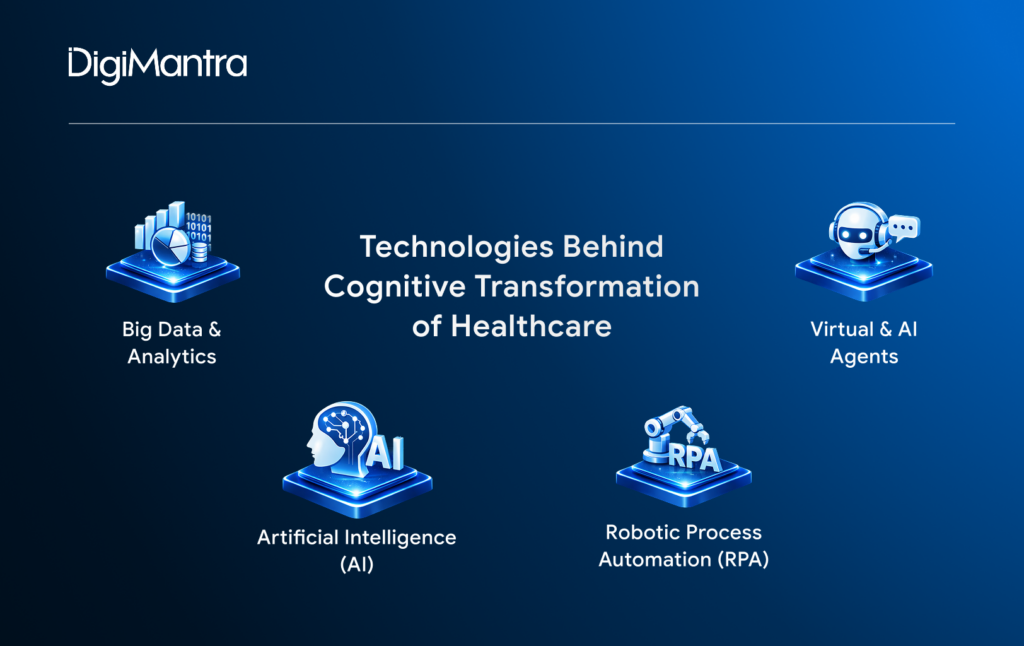
AI in healthcare operations is redefining how patients access care, expanding the ways providers deliver services, and driving measurable improvements in health outcomes. Rather than replacing existing systems, the intelligent healthcare administrative automation strengthens them, amplifying the value of every organisational asset, from data to human expertise. In healthcare, intelligent automation takes multiple forms:
- Big data and analytics– As healthcare data continues to grow in volume and variety, organisations need advanced platforms that can store, manage, and analyse information from multiple sources. The goal is no longer just data collection but turning fragmented data, structured or unstructured, into actionable insights.
- Artificial intelligence (AI)– AI enables healthcare organisations to interpret massive volumes of data, nearly 80% of which is unstructured. Using natural language processing, machine learning, and deep learning, AI-powered systems enhance care delivery, predict patient behaviour, and improve the efficiency of both clinical and non-clinical workflows.
- Robotic process automation (RPA)- By automating repetitive, rule-based tasks such as claims processing, RPA can reduce manual effort and operational costs by up to 80%. Research from KPMG shows that RPA initiatives have delivered cost reductions of up to 75% in financial services, with payback periods ranging from months to a few years.
- Virtual & AI agents – Powered by AI and natural language processing, virtual and AI agents deliver real business value by managing targeted tasks across functions. From customer service and sales to employee engagement, virtual agents enable faster, more consistent interactions at scale.
Together, intelligent automation improves capacity, cost efficiency, quality, and consistency of care. Working alongside healthcare employees, it reduces manual workload and accelerates the administrative processes that often slow the system down.
A study by Oracle and Future Workplace highlights this shift, showing that 36% of employees believe emerging technologies will help them develop new skills, another 36% expect to gain more time for meaningful work, and 28% anticipate evolving into more strategic roles.
How AI Agents Work in Healthcare
To truly understand what AI in healthcare operations looks like today, learn about AI agents, intelligent software assistants designed to carry out tasks independently, without constant human supervision. Unlike traditional rule-based tools such as robotic process automation in healthcare (RPA), AI agents don’t just follow scripts. They understand intent, adapt to changing situations, and intelligently coordinate workflows. This allows them to handle multi-step actions, like rescheduling appointments and alerting care teams, without manual handoffs.
The AI agents in healthcare can read context, make informed decisions, and take meaningful actions, such as summarising clinical interactions or updating electronic health records. What once felt experimental has quickly become essential, especially in communication-heavy and rule-driven workflows.
By following logic, accessing APIs, maintaining context across steps, and even collaborating with other agents, AI agents are redefining how healthcare operations function – faster, smarter, and with far less friction.
Specific Use Cases of AI Agents in Transforming Healthcare Workflows
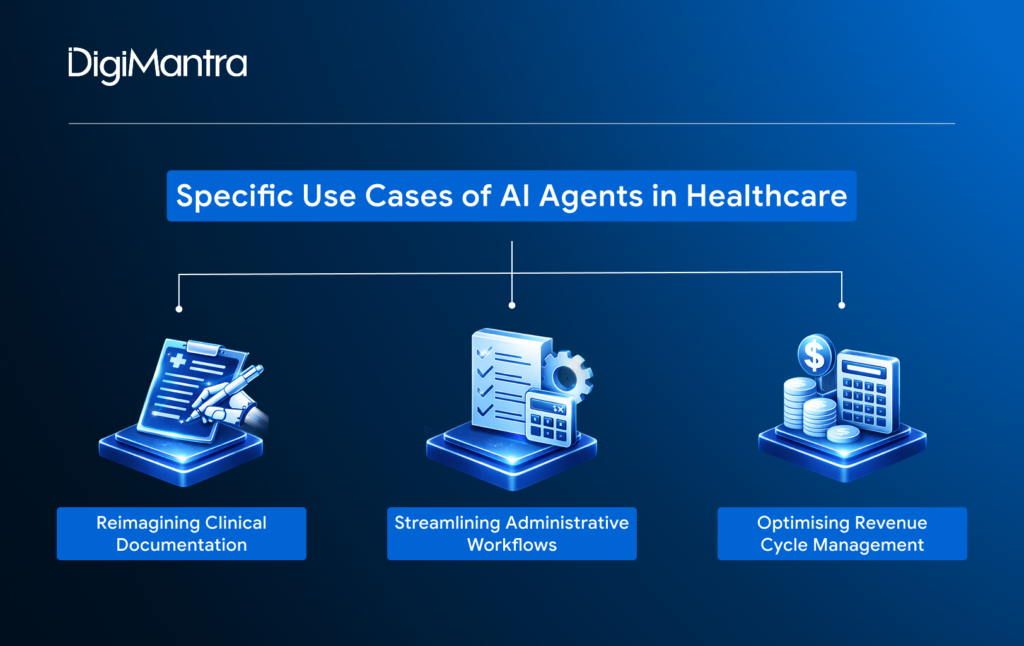
These real-world examples show how AI agents are powering healthcare automation by streamlining administrative workflows, improving care coordination, and enabling faster, more efficient operations across healthcare organisations.
-
Reimagining Clinical Documentation
AI agents are transforming clinical documentation by automatically drafting SOAP notes, transcribing patient visits, and managing voice-based inputs. One of the most impactful advances is ambient AI, which quietly captures conversations or observes clinician actions in real time to generate accurate, structured clinical notes.
The result is a more natural care experience; doctors can focus on meaningful conversations with patients instead of typing notes during the visit.
-
Streamlining Administrative Workflows
Beyond the exam room, AI agents play a critical role in automating patient intake and appointment scheduling, handling post-visit follow-ups, updating CRM and EHR systems, and coordinating internal communication through tools like Slack.
When administrative workflows are fully optimised, healthcare organisations report time savings of up to 70 minutes per patient visit, freeing clinicians to see more patients or spend more time on care.
-
Optimising Revenue Cycle Management
AI agents are also reshaping revenue cycle operations. Healthcare organisations using advanced AI systems report faster insurance verifications, smoother authorisation workflows, and improved visibility into claim denials.
By reducing delays in follow-ups and improving denial insights, these systems increase operational efficiency and expand staff capacity, which is an especially critical advantage amid ongoing provider shortages.
Benefits of Intelligent Automation in Healthcare Administration
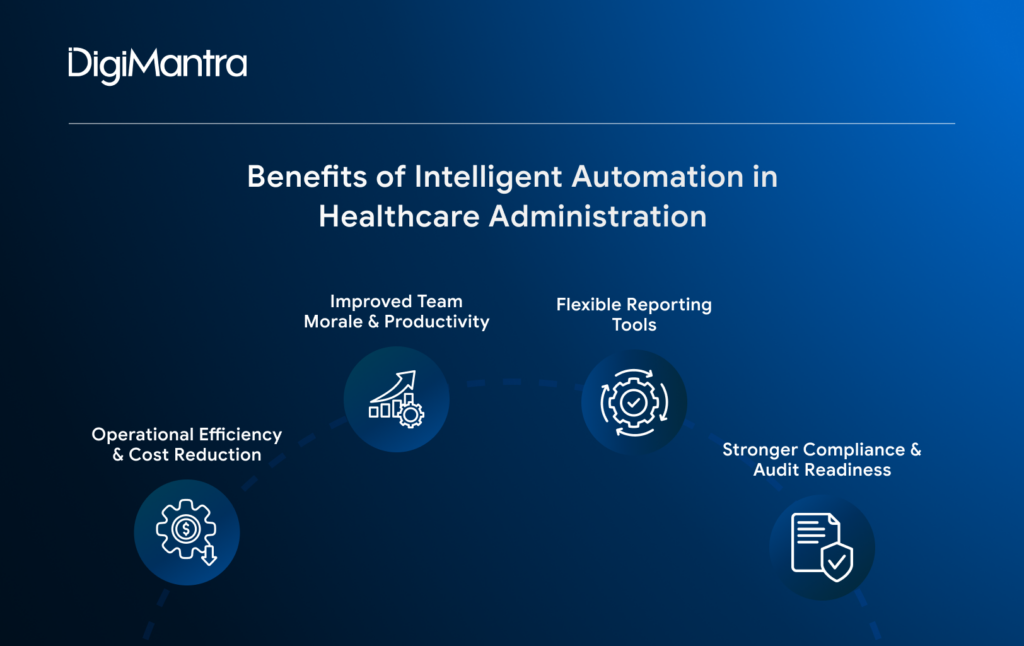
Healthcare organisations have moved beyond experimentation and are implementing automation because it consistently delivers real financial and operational results. The value extends well beyond saving time.
AI-powered virtual assistants handle patient questions, send reminders, and share instructions in a patient’s preferred language, while intelligent automation quietly manages the rest of the administrative workload in the background.
Operational Efficiency and Cost Reduction
Tasks that once took billing teams days to complete are now finished in a matter of hours. Staff members who spent entire mornings making appointment reminder calls can redirect their time toward helping patients with more complex needs.
When scheduling and routine communication are automated, organisations can support the same patient volume with fewer administrative resources. In many cases, the savings on operational costs are enough to offset the investment in healthcare operations automation within the first year.
Improved Team Morale and Productivity
By removing repetitive administrative work, automation allows healthcare professionals to focus on the roles they were trained for. Medical assistants spend more time with patients instead of managing forms, while billing specialists can concentrate on complex cases rather than being overwhelmed by routine claims.
This shift toward meaningful work doesn’t just improve output; it improves morale as well. Teams that aren’t buried in paperwork experience less stress, higher job satisfaction, and are better positioned to deliver quality patient care.
Consistency and Accuracy
Human error is inevitable in manual processes. A single incorrect billing code entered at the front desk can lead to rejected claims and delayed payments.
Automation-driven administration minimises these risks by delivering consistent, accurate processing every time. Fewer errors mean fewer delays, less rework, and significantly less time spent correcting avoidable mistakes.
Stronger Compliance and Audit Readiness
Maintaining compliance becomes far easier when nothing falls through the cracks. With automation, every interaction, claim, and update is automatically recorded and organised, eliminating the need to chase files or sift through stacks of paperwork during audits.
Even more valuable, automated systems flag potential compliance issues before they escalate. Instead of reacting to problems after the fact, organisations stay ahead of regulations, fully prepared when auditors arrive.
Key Applications of AI-Powered Healthcare Systems
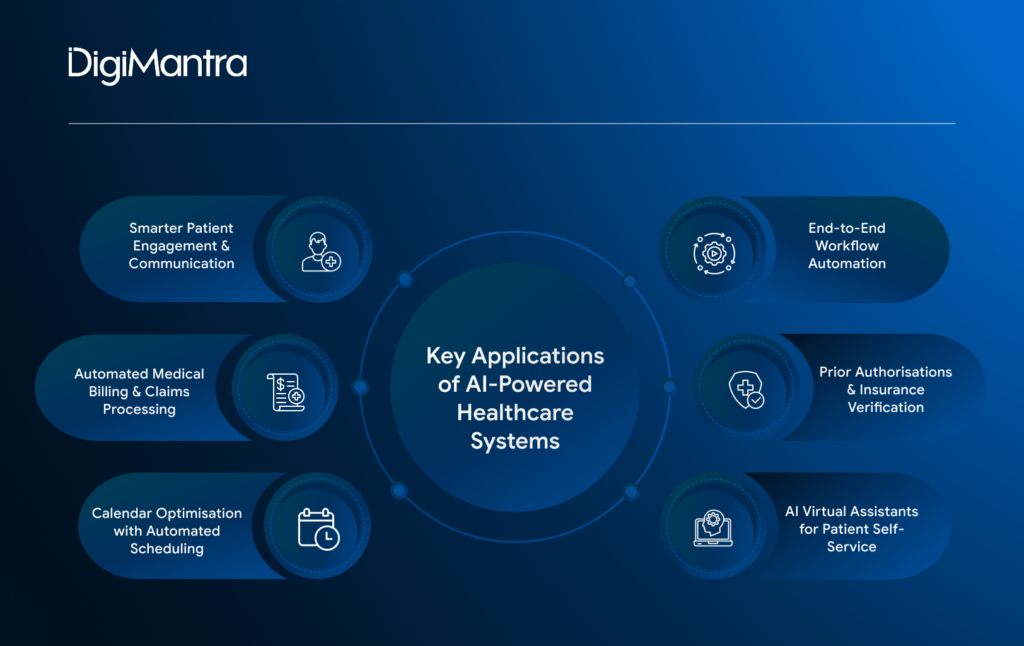
Healthcare organisations are no longer waiting to see whether AI delivers value; they’re already using it and seeing measurable results. Hospitals and clinics are cutting billing cycles dramatically, improving appointment attendance, and freeing staff from administrative overload so they can focus on higher-impact work. Here’s what’s driving real change today:
-
Smarter Patient Engagement and Communication
Healthcare teams spend countless hours repeating the same information. AI and automation eliminate that repetition. Appointment reminders are automatically delivered through the right channels, and patients receive timely follow-up messages after every visit.
Where AI truly shines is “intelligent patient engagement”. Patients can send a text at any time, day or night, and receive instant, accurate responses to questions about billing, care instructions, prescriptions, appointments, and more. The experience is immediate, convenient, and always available when patients need support.
-
Automated Medical Billing and Claims Processing
AI-powered billing systems streamline invoicing, reminders, and even payment processing, significantly reducing daily administrative workload. When patients have billing questions, intelligent virtual assistants step in to provide answers and share secure payment links. From start to finish, the system guides patients through the process without requiring a live agent.
-
Calendar Optimisation with Automated Scheduling
Automated scheduling systems account for details that humans often miss, such as provider availability, appointment types, patient history, travel considerations, and urgency. When cancellations occur, the system automatically fills open slots using waitlists, prioritising patients who need care most or have been waiting the longest.
-
End-to-End Workflow Automation
With healthcare automation in place, repetitive administrative tasks run seamlessly in the background. Patient intake forms are processed automatically, with information flowing directly into the EHR. Lab results reach the appropriate clinician, insurance updates are routed to billing, and patient messages are organised by priority, without manual intervention.
-
Prior Authorisations and Insurance Verification
Insurance verification no longer has to slow things down. Patients can complete forms, confirm coverage, sign documents, and even submit copays before arriving, using their phone or computer. All information is collected in advance and pushed directly into patient records, keeping appointments on schedule and reducing friction for everyone involved.
-
AI Virtual Assistants for Patient Self-Service
Patients can interact with AI through websites, text messages, or voice assistants to get quick answers without calling the office. Whether they’re asking about accepted insurance, service animals, or evening appointments, the system responds instantly.
More advanced AI virtual assistants in healthcare allow patients to book appointments, request prescription refills, or cancel visits using natural language. This self-service approach dramatically reduces front-desk call volume, eliminating repetitive questions and creating a smoother experience for both patients and staff.
AI Challenges in Healthcare, and How to Overcome Them
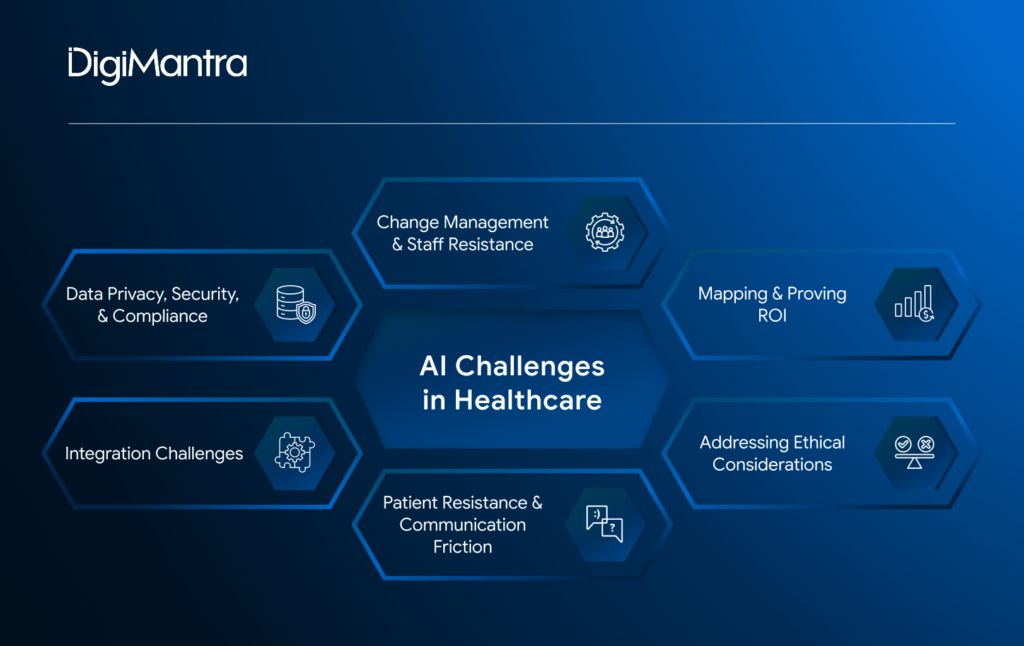
Healthcare organisations want the benefits AI promises, but the path to adoption isn’t always smooth. Privacy regulations, legacy technology, and workforce resistance can all slow progress. The organisations that succeed are the ones that plan early, set realistic expectations, and choose technology partners who understand healthcare’s unique demands.
Data Privacy, Security, and Compliance
Healthcare data breaches cost organisations millions each year, making patient information one of the most valuable targets for cyberattacks. As AI systems process sensitive health data, leaders must be confident about where information is stored, who has access to it, and how it’s protected. That’s why strict compliance with HIPAA regulations is non-negotiable for any healthcare AI solution.
Integration Challenges
Many healthcare systems were designed long before AI entered the picture. While EHRs and billing platforms may communicate with each other, integrating modern AI tools often creates friction. Disparate systems, incompatible data formats, and limited interoperability can leave IT teams spending months on complex integrations.
Change Management and Staff Resistance
AI adoption can raise concerns among healthcare professionals who fear losing control over patient interactions or being replaced by technology. Many staff members are cautious about tools that appear unfamiliar or impersonal, especially in an industry built on trust and human connection.
Patient Resistance and Communication Friction
Patients don’t always feel comfortable interacting with AI, especially when it comes to healthcare. Some prefer speaking with a person, while others may struggle with automated systems due to language barriers or limited technical familiarity.
Mapping and Proving ROI
Hospital leaders need clear evidence that AI investments deliver measurable value. Yet traditional ROI models often overlook benefits like reduced staff burnout or improved patient satisfaction, making it difficult to justify spending.
Addressing Ethical Considerations
Bias, transparency, and accountability remain critical concerns in healthcare AI. Organisations must ensure AI systems are fair, explainable, and supported by clear oversight policies.
Conclusion
Healthcare is entering a phase where operational excellence will matter as much as clinical innovation. The intelligent healthcare automation is quietly becoming the connective layer that holds complex systems together by linking data, people, and processes without adding friction.
The organisations that move forward won’t be defined by how much technology they deploy, but by how thoughtfully they integrate it. When AI is designed around trust, adaptability, and real-world workflows, it stops being a tool and starts becoming an enabler of better care, stronger teams, and sustainable healthcare operations.
Discover what intelligent healthcare administration looks like in practice. Book a demo with DigiMantra today.

AI-FIRST ENGINEERING FOR MODERN BUSINESSES
Designed for performance. Powered by innovation.
 Product Development
- Custom Software
 Mobile & Web
- AI & Automation
- Cloud Management
- Intelligent Systems