

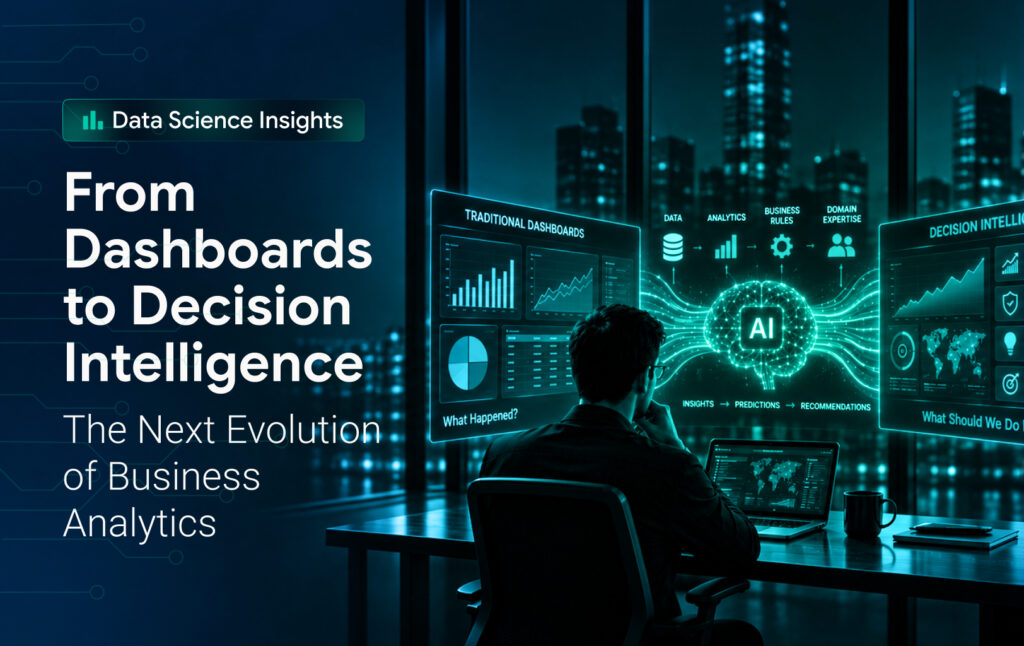
Today, businesses are creating more data than ever before. Every interaction between a company and its customers generates valuable data. Even though many companies continue to use old-fashioned dashboards to monitor their progress, these tools often focus on historical data from the previous day, which may not provide clear guidance on what actions to take next.
Decision Intelligence is making a difference.
It goes beyond showing charts and reports. It combines artificial intelligence, machine learning, predictive analytics, business rules, and domain expertise to recommend actions before potential issues become significant business problems.
It is revolutionising business analytics from passive reporting into active decision-making. Many companies are now embracing AI-based business analytics to support faster and more informed decision-making.
In this blog, we will explore Decision Intelligence, understand how it differs from traditional dashboards, discover why businesses are adopting it, and discuss how organisations can prepare for this next evolution of business analytics.
What is Decision Intelligence?
Decision Intelligence is an approach that combines data, analytics, AI, business rules, and human expertise to support better business decisions. It helps companies not only understand what is happening but also determine what to do next.
Traditional dashboards answer questions like:
- How many sales were made this month?
- Which marketing campaign was the most successful?
- What was the revenue made this quarter?
Decision Intelligence goes further by asking questions like the following:
- Which customers will churn this month?
- Which products need to be replenished to prevent stock-outs?
- In what price range can we maximize our profit?
- What should the managers do today?
Beyond just providing information, it suggests the next steps. This makes the analysis more focused on the future. This shift shows how AI-powered business systems are becoming better at supporting decisions as they happen.
Why Traditional Dashboards Are No Longer Enough
Business dashboards transformed reporting by making data easier to access and understand. However, they have several limitations:
- Business dashboards mainly report data.
- Users must manually interpret trends.
- Decision-making remains slow.
- Critical opportunities may be missed.
- Large amounts of data create information overload.
For example, an eCommerce dashboard may show declining sales. The dashboard tells you what happened. The dashboard may not explain the best course of action.
Decision Intelligence can identify causes, pricing, customer behaviour, inventory availability or competitor activity, and recommend immediate actions.
How Does Decision Intelligence Actually Work?
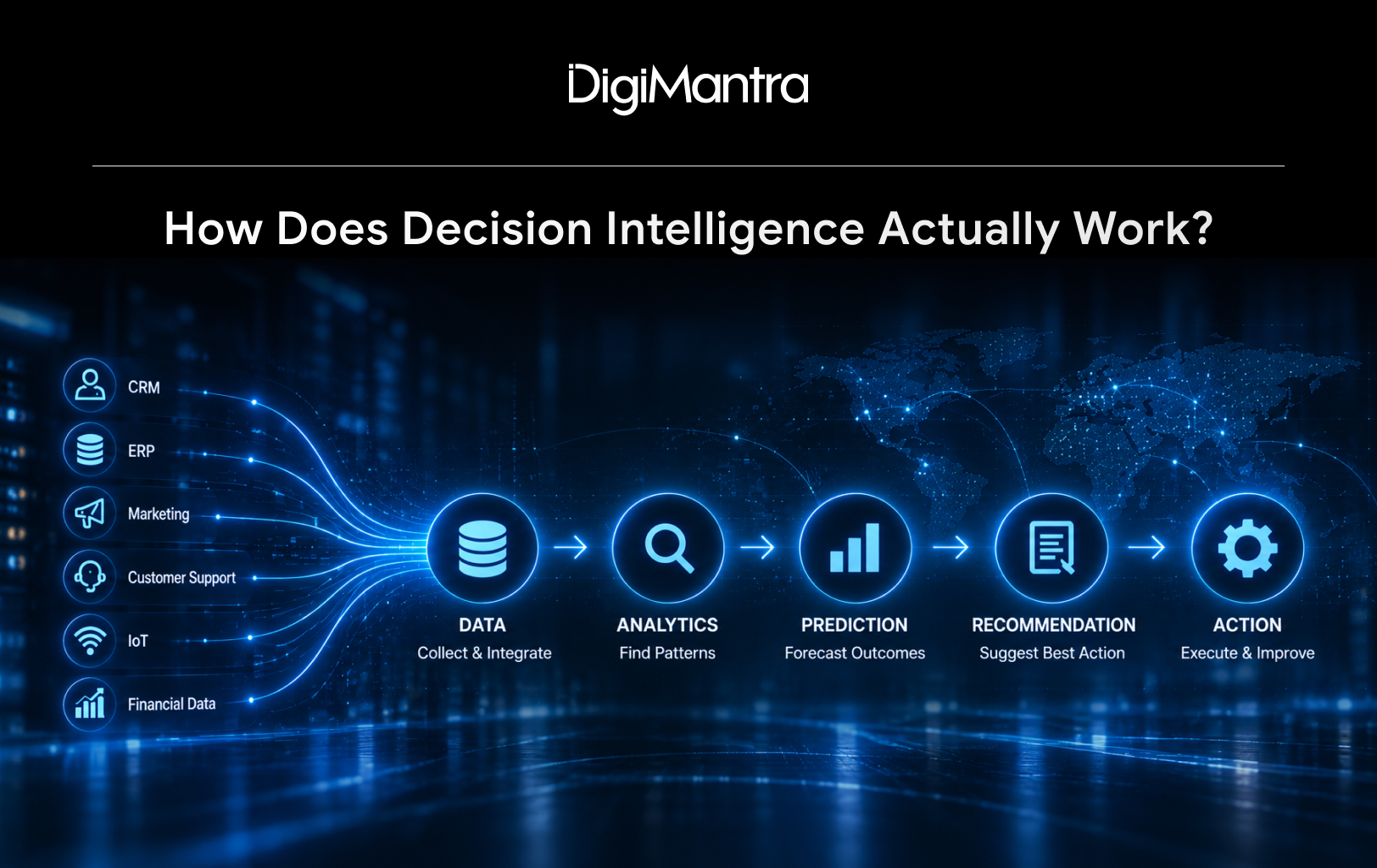
Decision Intelligence brings multiple technologies and sources of business knowledge together into a structured decision-making process.
It gathers data from sources such as CRM systems, ERP platforms, marketing tools, customer support systems, IoT devices and financial software.
With the help of AI and machine learning, Decision Intelligence does more than simply collect data. It identifies patterns, makes predictions, and uncovers connections that may be difficult to detect manually.
Decision Intelligence also looks at the company goals, budget, rules and operational limits. This helps ensure that its recommendations are aligned with the specific business context.
Ultimately, Decision Intelligence provides recommendations, priorities, or automated actions. Rather than simply displaying numbers, Decision Intelligence connects insights with recommendations and actions, helping teams make faster and more informed decisions.
This can be achieved through several steps:
1. Gathering of Business Data: The initial stage involves gathering data from various business systems. For instance, a retail company can gather such data as:
- Sales data
- Consumer behaviour
- Inventory levels
- Website traffic
- Marketing performance
- Competitor pricing
- Supply chain data
This allows the decision system to have a clearer picture of the business.
2. Understanding What Is Happening: AI and analytics use the data to detect patterns and correlations, as well as any anomalies. If an organisation notices that its sales have declined in one particular market, the system can help identify potential causes, such as pricing changes, reduced demand, insufficient stock, or underperforming marketing campaigns.
3. Predicting What Could Happen: Predictive models estimate what is likely to happen in the future. For instance:
- A customer may be at high risk of churn.
- Demand for a product may increase next month.
- A supplier may be at risk of delivering late.
- A marketing campaign may generate lower returns.
4. Suggesting the Action to Take: This is where Decision Intelligence differs from conventional reporting. The software can assess various courses of action and suggest the one which best suits the business objective. For instance, in case of an anticipated increase in demand, it may recommend stocking up rather than just showing the forecast.
5. Learning from Outcomes: The Decision Intelligence process does not stop once a decision has been recommended. Outcomes can then be monitored, allowing the organisation to learn which decisions were effective and continuously improve future recommendations.
Decision Intelligence vs Traditional Business Dashboards
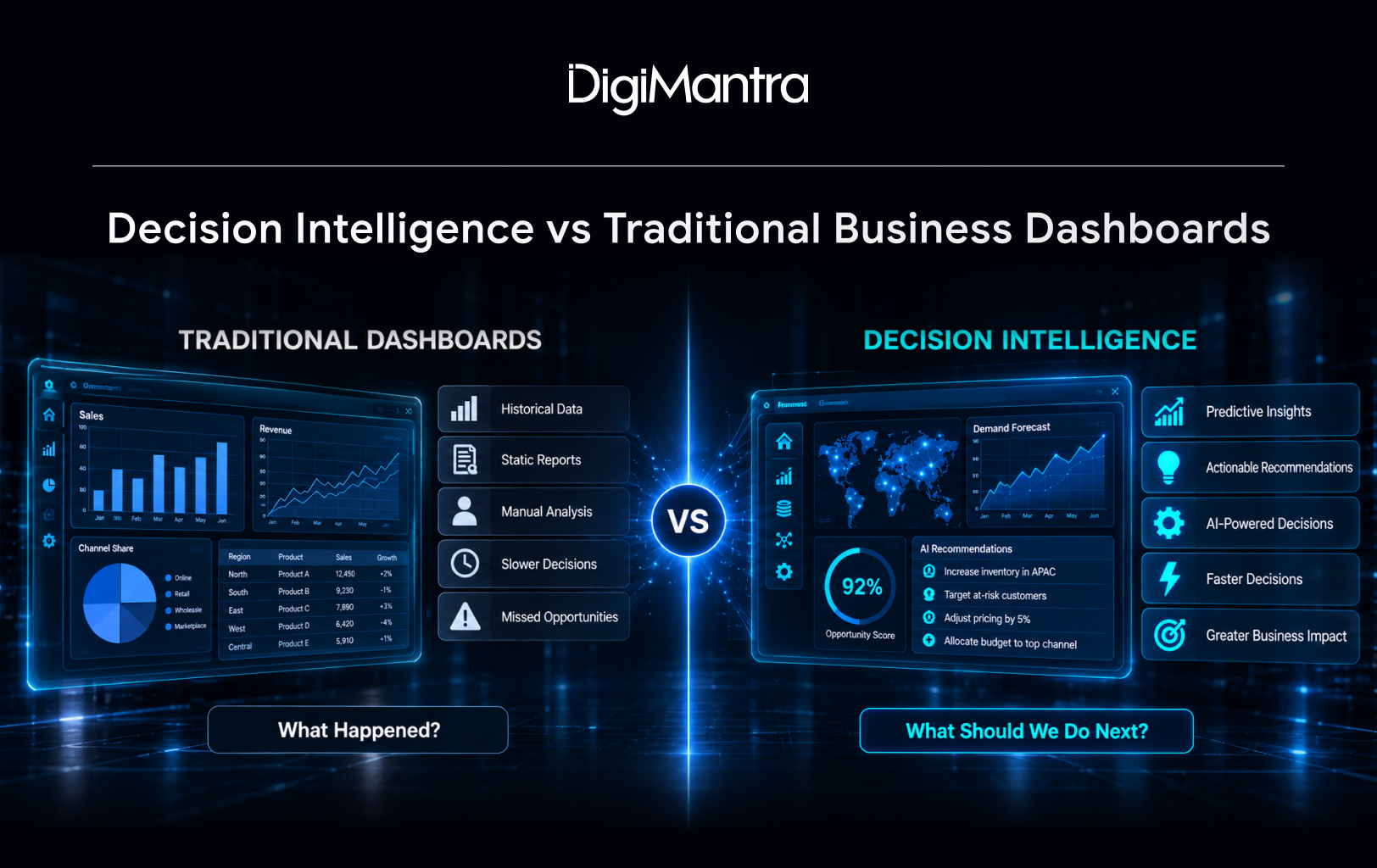
Traditional dashboards and Decision Intelligence don’t have to be competing solutions. They work on different stages of the decision-making process. The purpose of a dashboard is to make the information visible and understandable for the user. The goal of Decision Intelligence is to analyse information, evaluate possible actions, and support better decisions.
| Traditional Dashboards | Decision Intelligence |
| Shows what happened | Explains what may happen next |
| Focuses on KPIs | Focuses on business decisions |
| Mostly descriptive | Predictive and prescriptive |
| Requires manual interpretation | Provides recommendations |
| Reports information | Connects insights to actions |
| Often reviewed periodically | Can support continuous decisions |
| Human-led analysis | Human + AI decision support |
For example, an old-style sales dashboard will let us know that the company’s revenue has fallen by 12%. Decision Intelligence can go further by providing possible explanations, predicting potential consequences, comparing different courses of action, and recommending an appropriate next step. However, this does not mean that human involvement becomes unnecessary. Rather, Decision Intelligence enables humans to make an informed decision.
Reasons for the Emergence of Decision Intelligence in Business
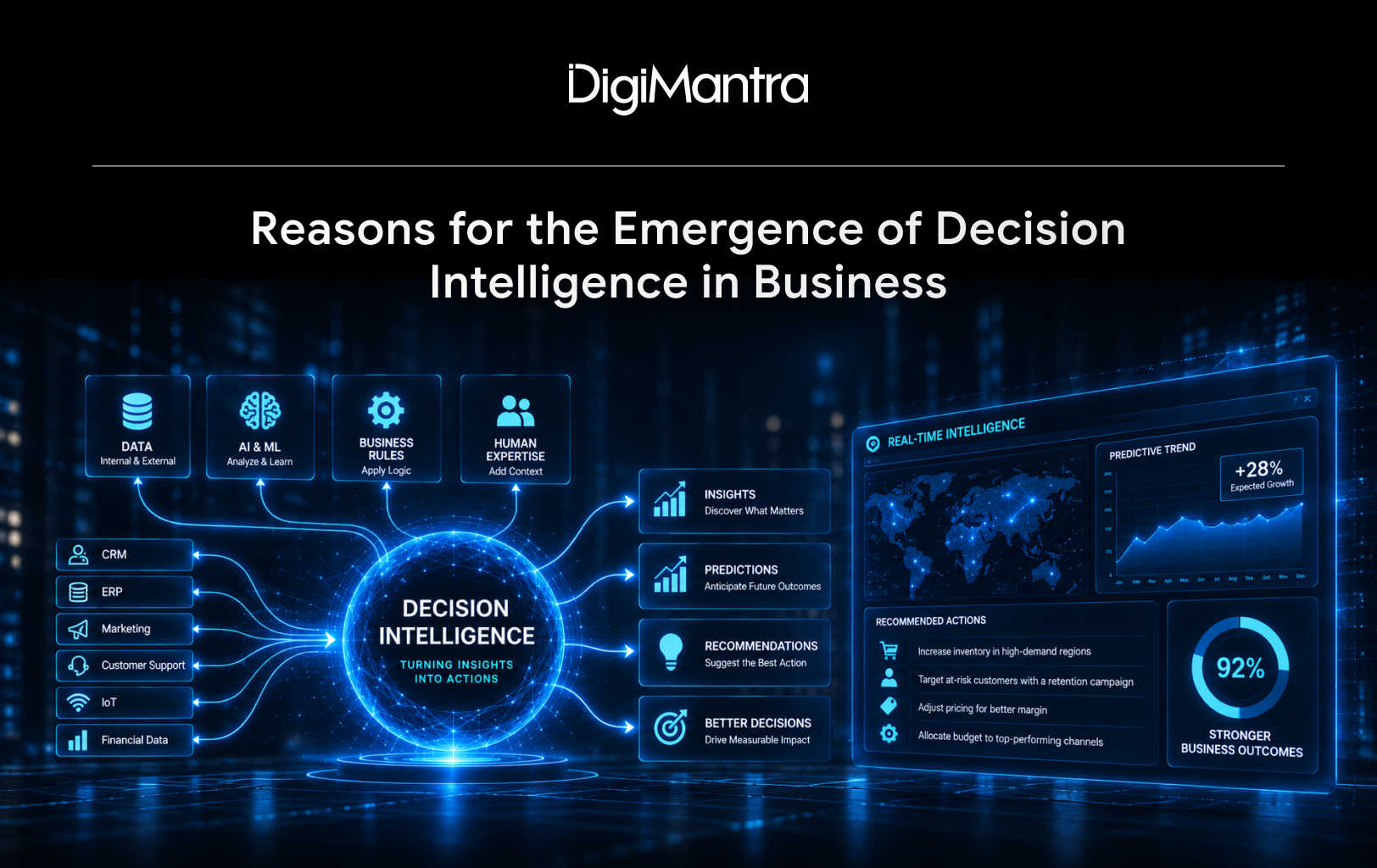
Interest in Decision Intelligence is growing for several reasons. One key reason is that businesses now have access to more data than ever, but more data does not necessarily lead to better decisions. Today’s businesses operate in many different environments and channels. The manual correlation of all these signals by analysts could lead to decision delay. There are several possible solutions which Decision Intelligence can offer for this problem.
1. Quick Decision-Making Process
In some cases, companies must make rapid decisions in response to changes in consumer behaviour, logistics, market trends, and business risks. Decision Intelligence keeps track of all these signals and alerts you regarding these changes without any periodic reporting.
2. More Accurate Forecasting
This forecasting capability can help predict areas such as demand, customer behaviour, and sales performance. However, forecasts are not guarantees of future outcomes. They provide businesses with data-driven insights that can help them prepare for potential scenarios
3. Less Decision-Making Delays
The biggest problem of traditional analytics approach is the delay in making decisions because of the gap between insights and actions. Decision Intelligence solves this problem.
4. Consistency in Decision-Making
There may be situations where the decisions of the companies depend on the individual who makes the decisions. Decision Intelligence brings consistency in the policies, constraints, and decision-making criteria of the repetitive business processes of the business.
5. Better Utilisation of Data
Companies spend a lot of money and time in gathering and accumulating data. Decision Intelligence makes use of the gathered data by linking it with the decisions of the company and their outcomes.
6. Supporting High-Volume Decision-Making
Some businesses make hundreds, thousands, or even millions of individual decisions every day. Some examples of such decisions are:
- Fraud detection
- Product recommendations
- Pricing
- Inventory
- Customer retention
- Credit decisions
- Marketing Optimisation
It is impractical for teams to evaluate every such decision manually.
Decision-making systems with the involvement of AI can assist in prioritising these decisions and automating appropriate actions.
How Does Generative AI Relate to Decision Intelligence?
Generative AI can serve as an additional layer within Decision Intelligence.
Traditional analytics solutions often require users to understand dashboards, filters, reports, and analytical tools. A natural language interface allows users to ask questions such as:
“Why did sales decrease this month?”
or
“What target group should we focus on in the near future?”
The system interprets the question, retrieves the relevant business data, analyses it, and presents the findings in an accessible format.
Generative AI can also explain the reasoning behind particular recommendations.
For example:
“Sales are projected to decline in Region A due to an 8% reduction in demand and a 5% price advantage among competitors. The system recommends increasing promotional activity to improve conversion.”
This makes analytics more accessible to business users without requiring advanced technical skills.
However, the decision generated by the generative AI should never be treated as flawless. The business data must be verified in accordance with the business rules.
The Future of Decision Intelligence
The future of business analytics will not necessarily mean eliminating dashboards. Instead, dashboards will increasingly become a component of a broader intelligence layer.
The evolution is going to follow the following sequence:
Descriptive Analytics to Diagnostic Analytics to Predictive Analytics to Prescriptive Analytics to Decision Intelligence to Agentic Execution.
Each stage adds a greater level of intelligence:
- Descriptive Analytics explains what has happened.
- Diagnostic Analytics helps identify why it happened.
- Predictive Analytics estimates what is likely to happen next.
- Prescriptive Analytics recommends potential actions based on predicted outcomes and business objectives.
- Decision Intelligence connects these insights with business decisions, rules, and outcomes.
- Agentic Execution takes this a step further by enabling AI-powered systems to execute predefined actions autonomously, where appropriate and under suitable governance.
This evolution does not mean that dashboards will become obsolete. Instead, they will continue to provide visibility into business performance while becoming one component of a larger intelligence ecosystem.
The ultimate shift is from simply viewing data to understanding it, deciding what to do, and taking action.
Key Takeaways
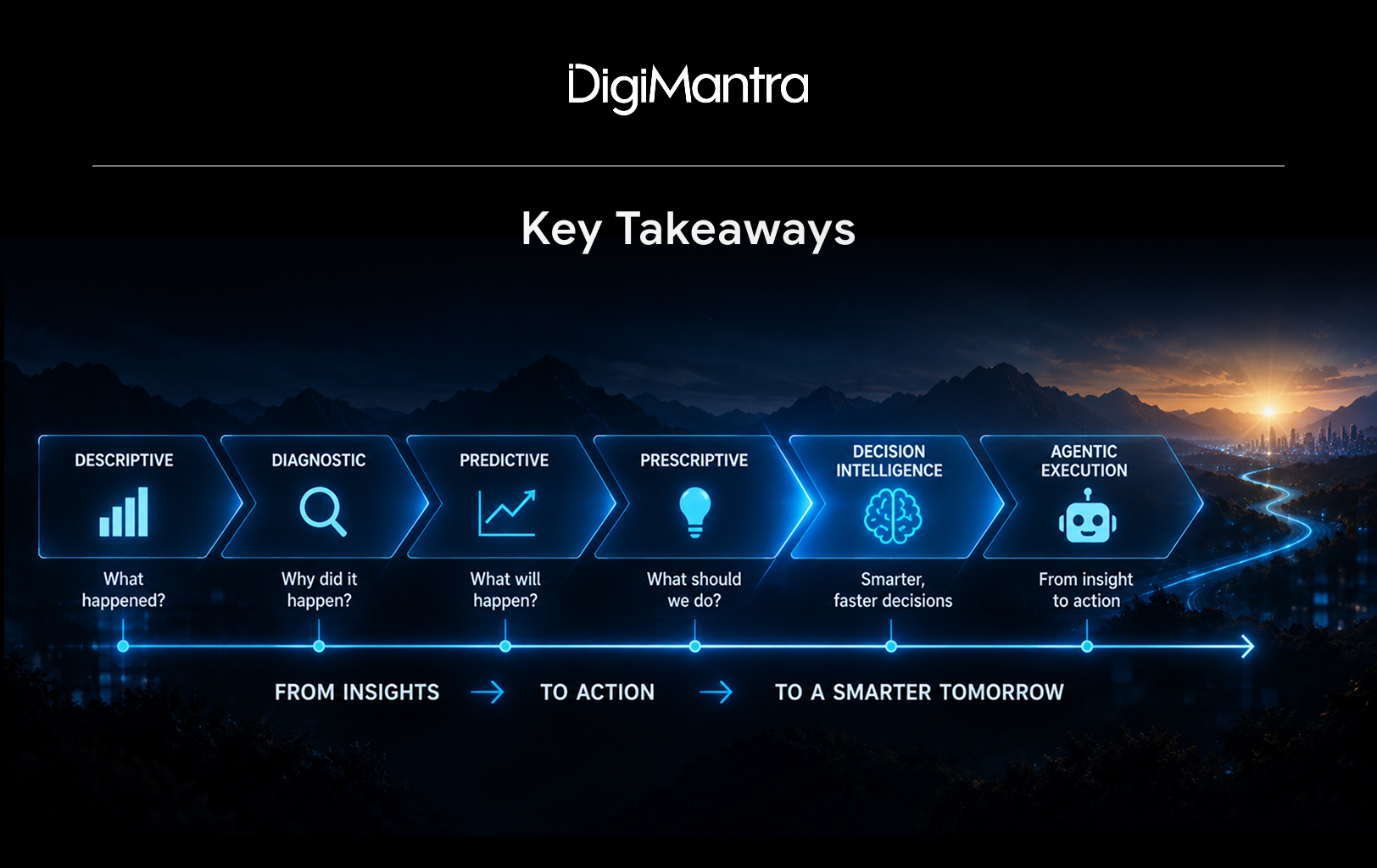
Decision Intelligence represents the evolution of business analytics from reporting and insights towards recommendations and action. Rather than replacing dashboards, it can build on them by combining data, AI, predictive models, business rules, and human expertise. Traditional dashboards continue to provide valuable visibility into performance metrics and business results.
However, Decision Intelligence helps to understand possibilities, evaluate alternatives and define actions. Decision Intelligence has applications across industries such as retail, finance, healthcare, manufacturing, marketing, and logistics. But there are some prerequisites for implementing Decision Intelligence besides advanced AI technology.
First, organisations need high-quality data and well-defined decision processes. Other requirements include effective governance, explainability, human oversight, security, and integration with existing business systems. With the development of AI technologies, the new generation of business analytics tools will start shifting from information provision to decisions and even decisions’ execution when it is needed.
The goal should not simply be to build smarter dashboards, but to create intelligent systems that help organisations move from information to insight, from insight to decisions, and ultimately from decisions to measurable business outcomes.

AI-FIRST ENGINEERING FOR MODERN BUSINESSES
Designed for performance. Powered by innovation.
 Product Development
- Custom Software
 Mobile & Web
- AI & Automation
- Cloud Management
- Intelligent Systems