




Neuromorphic computing presents a completely different way of working. It is inspired by how the human brain is structured and functions. These systems are built using brain-like designs, such as neurons and synapses, and they use a method called event driven computation. Unlike traditional computers that constantly process large amounts of data, neuromorphic systems only handle information when specific events happen. This can make them more efficient and quicker to respond.
Artificial intelligence is developing quickly, but the rising need for AI is causing more strain on old computer systems. As AI models get more complex, they need more processing power, memory, and energy, which brings new difficulties for companies creating and using smart systems.
AI is Evolving: Why Does Hardware need to evolve too??
AI has usually used CPUs, GPUs, and special accelerators to handle more complex tasks over time. These technologies have helped make big progress in machine learning and generative AI, but as AI grows, it also needs more computing power and energy.
This is especially important for AI that runs on edge devices, robots, self-operating systems, smart sensors, and other applications that need to work locally with limited power and fast response times. Because of this, there’s growing interest in neuromorphic computing. Companies are looking into new ways to build AI systems that are more efficient and quicker to respond.
Neuromorphic computing isn’t just about making processors faster. It’s about changing the way computers handle, process, and learn from information. By combining memory and processing more efficiently and using a type of processing that only activates when needed, neuromorphic systems offer a new way to build energy-efficient AI hardware. In this blog, we’ll explain what neuromorphic computing is, how it functions, why it’s important for AI, and how Mobile App Development Services can benefit from advancements in energy-efficient AI hardware.
Understanding Neuromorphic Computing
Neuromorphic computing is a way of designing hardware and software that mimics how the human brain works. Instead of using traditional computer systems,
neuromorphic systems try to copy the main features of biological neural networks, such as neurons, synapses, parallel processing, and communication that happens only when needed.
Many neuromorphic systems use something called Spiking Neural Networks, or SNNs. Unlike regular artificial neural networks, which use continuous numbers
to process information, SNNs send data through short electrical pulses called spikes. A neuron in an SNN collects signals and sends out a spike when it reaches a certain level of activity. This means the system only does computations when something important happens, rather than constantly working through every piece of data.
- How Does Neuromorphic Computing Work?
Neuromorphic computing uses special hardware designs along with algorithms inspired by the brain to build systems that process information in a way that’s spread out and very efficient.
The main ideas behind this are:
- Spiking neurons: These artificial neurons send out quick signals, or “spikes,” when certain conditions are met.
- Synaptic connections: The links between neurons pass along information and can change strength, which helps the system learn and remember relationships.
- Event-driven processing: The system only does computations when something happens or changes, instead of constantly running through all the data.
- Parallel processing: Many artificial neurons can work at the same time, making the system very fast at handling complex tasks.
This setup helps overcome a big issue with regular computers: moving data back & forth between memory and processing units. By only using computation when
needed and cutting down on unnecessary data movement, neuromorphic systems neuromorphic systems can be more energy efficient and quicker to respond.
Neuromorphic Computing vs Traditional Computing
Traditional computers work with a clock-based system where the processor keeps running through instructions and moving data between memory and processing parts. WPUs are very strong, they can use a lot of power and move a lot of data, a lot of data, especially for AI tasks.
Neuromorphic systems work differently. They are usually asynchronous, event- driven, and can process things in parallel. This means each part of the systems stays idle until useful information arrives. This design is especially useful for tasks that require constant monitoring, quick responses, and low power use.
Instead of just making current processors faster, neuromorphic computing is about building AI hardware that mimics how intelligent systems handle information.
Why Neuromorphic Computing Matters for AI
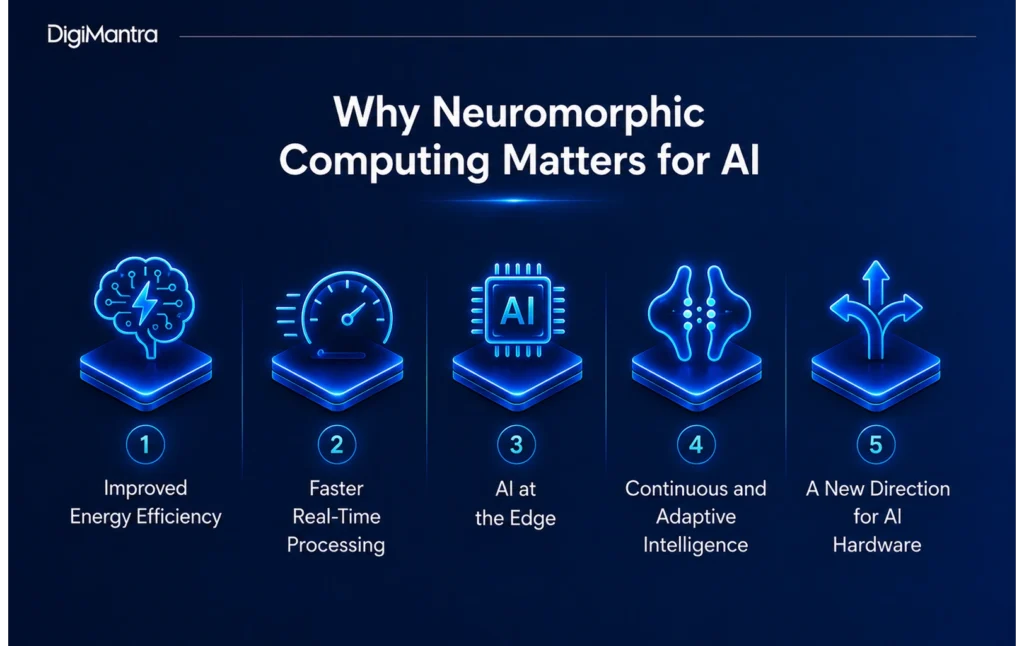
As AI systems become more powerful, the challenge is no longer just about making models bigger. The industry is also looking for new types of computing systems that can deliver smart capabilities while using less energy, responding faster, and working more efficiently. This is why neuromorphic computing is gaining interest as a possible next step in AI hardware.
1. Improved Energy Efficiency
Using energy wisely has become a big concern for AI systems. Traditional computer often wastes a lot of power moving data back and forth between memory and processors. Neuromorphic systems reduce this by using event-driven processing, where computation happens only when needed, like when specific events or signals happen.
2. Faster Real-Time Processing
Many AI applications can’t wait for long processing times. Machines that operate on their own, robots, security systems, and interactive devices often need to react quickly to their surroundings.
3. AI at the Edge
One of the key opportunities for neuromorphic computing is Edge AI. Instead of sending all the data to a central server or data centre, smart devices can process information right where it’s collected.
4. Continuous and Adaptive Intelligence
Neuromorphic computing can support systems that learn and change as they face new inputs. Ideas like neutral plasticity and learning directly on the
chip are being studied to let neuromorphic systems respond to changing situations without needing to rely on big retraining processes at a central location.
5. A New Direction for AI Hardware
Neuromorphic computing isn’t meant to replace GPUs or CPUs for every AI task. Instead, it offers a different way of building hardware that can work alongside existing systems.
Applications of Neuromorphic Computing
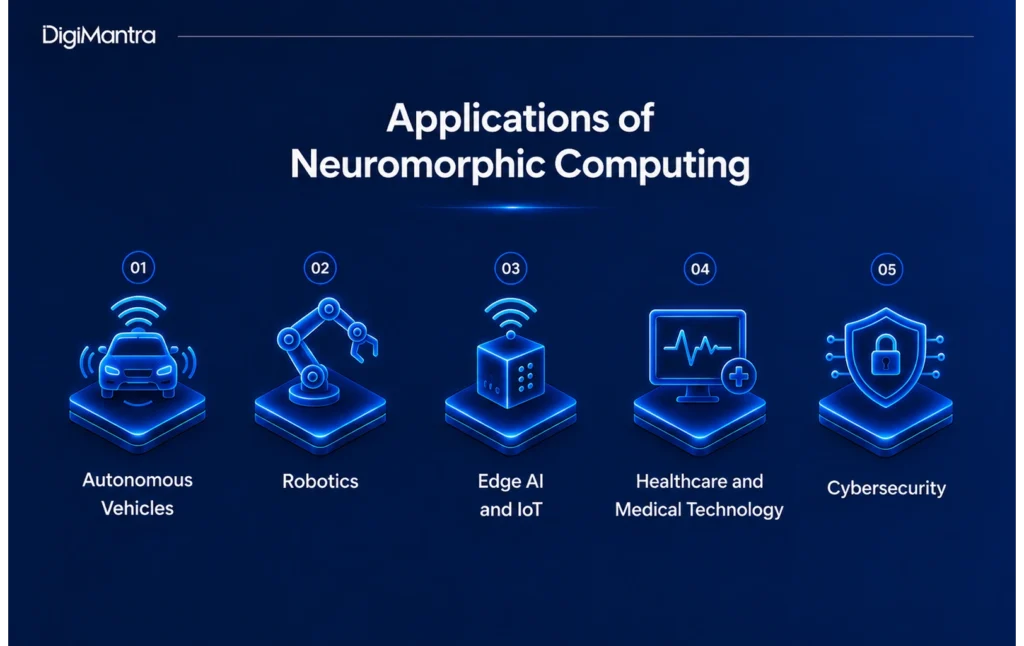
Neuromorphic computing is still a new and developing technology, but its ability to use low power, process information in parallel, and react quickly makes it a promising option for many AI applications. It has a strong potential in situations where systems must constantly monitor their surroundings and respond with very little delay.
1. Autonomous Vehicles
Autonomous vehicles need to process data from cameras, sensors, and other systems in real time. Neuromorphic computing could help these vehicles react quickly to changes in their environment and use less energy for continous sensing and processing.
2.Robotics
Robots that work in changing environments need to understand their surroundings, identify objects, make decisions, and adjust their actions continuously.
3. Edge AI and IoT
Edge devices often have limited battery life, processing power, and internet access. Sending all sensor data to the cloud can also create delays and raise privacy issues. Neuromorphic hardware can process information locally and start computing only when something important happens.
4. Healthcare and Medical Technology
Neuromorphic computing could be valuable in healthcare. Brain inspired systems can help with pattern recognition and analysing complex signals, such as medical images and neurological data.
5. Cybersecurity
Modern cybersecurity needs to spot unusual activity and act quickly to stop threats. Neuromorphic architectures could support real time pattern recognition by processing event streams and identifying anomalies as they happen.
Advantages and Limitations of Neuromorphic Computing
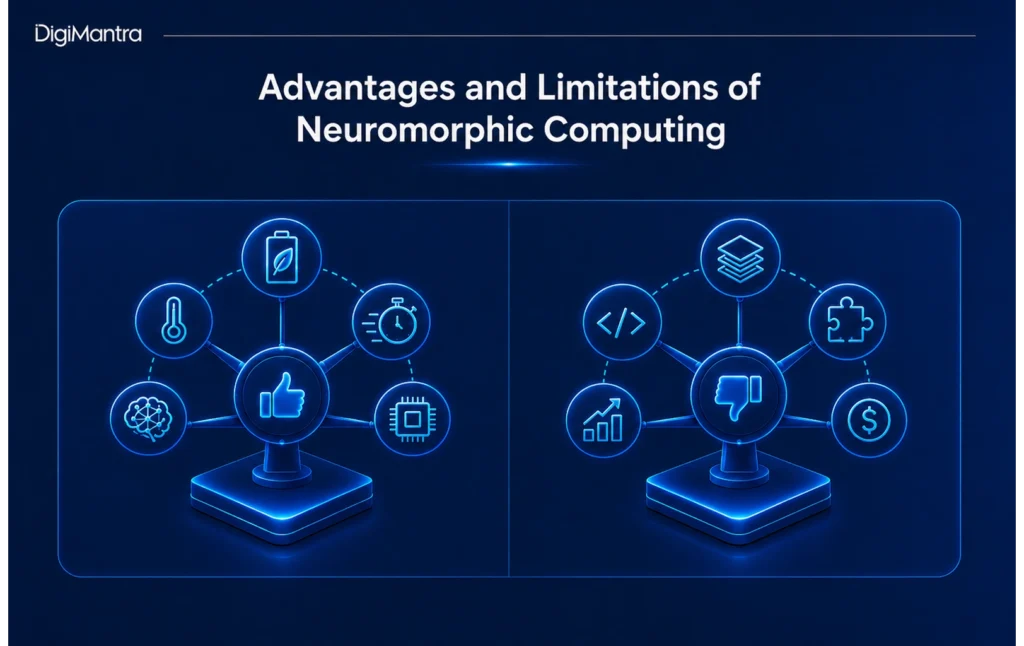
Neuromorphic computing presents a new way to handle AI tasks, but it isn’t a complete substitute for CPUs and GPUs. It shines in certain types of workloads
that benefit from sparse, event-based, parallel, and energy-efficient processing. Still, the technology has several challenges that need to be overcome, including hardware, software, scalability, and how quickly it can be adopt.
Neuromorphic Computing Advantages
• Lower Energy Use
Since neuromorphic systems only activate when something happens, they use less power. This makes them great for always-on devices and systems where power is
limited.
• Fast Processing
These systems can process events in real time and independently, which is helpful for applications that need quick responses to new information.
• Efficient Data Handling
Traditional AI systems use a lot of energy moving data around between memory and processors. Neuromorphic systems aim to cut down on this bringing
computation and memory together.
• Good for Edge AI
Because they are energy-efficient and can process data locally, neuromorphic computing is well-suited for edge devices, sensors, robots, and autonomous systems where sending data to the cloud isn’t efficient.
• Real-Time Learning
Research into neuromorphic computing is exploring ways for devices to learn and adapt on their own, allowing them to respond to changes in their environment without depending entirely on centralized systems for updates.
Neuromorphic Computing Limitations
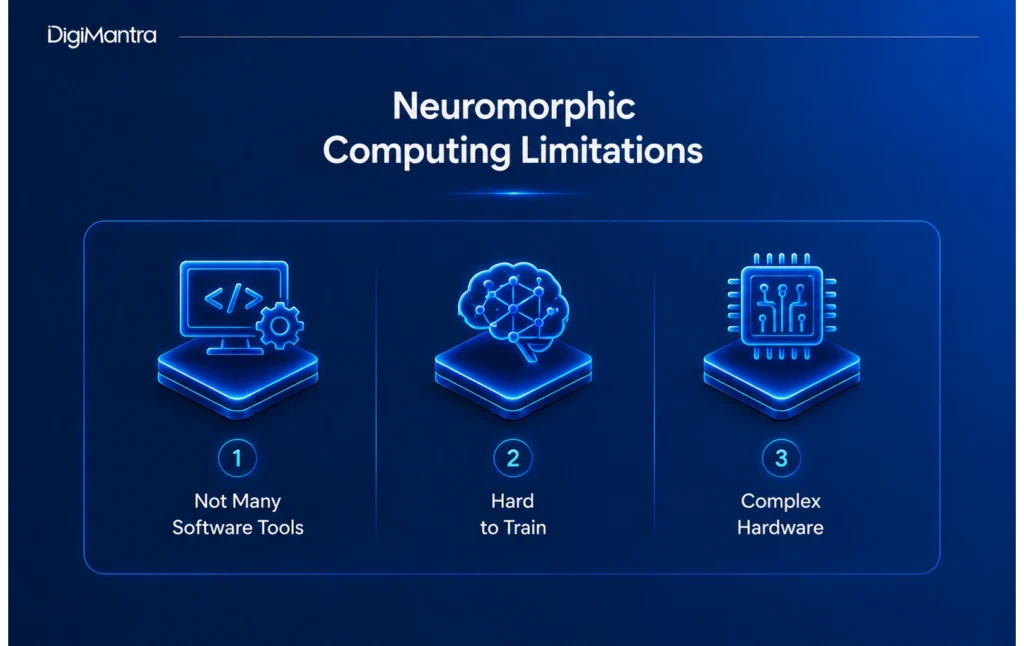
• Not Many Software Tools
Most AI development is built around traditional neural networks and GPUs. Neuromorphic systems need special programming models, tools, and algorithms, which can be hard for developers to learn.
• Hard to Train
Spiking neural networks, which are used in neuromorphic systems, can be more complicated to train compared to standard deep learning models.
There’s still a long way to go in making training methods as versatile as gradient-based techniques that are widely used in AI today.
• Complex Hardware
Creating neuromorphic processors requires unique designs and technologies.
Scaling these systems introduces issues related to device consistency, materials, manufacturing, memory, and integration with other systems.
The future of neuromorphic computing will depend on not just improving the hardware but also on creating better algorithms, software frameworks, tools, and methods that make it easier to use at scale.
Neuromorphic Computing v/s GPUs v/s CPUs
Neuromorphic computing is not just a quicker version of a CPU or GPU. It works in a completely different way when it comes to handling information. CPUs are built for general tasks, and GPUs are great for doing lots of math at the same time, Neuromorphic systems, on the other hand, are made to work like the brain, using a method that responds to events as they happen.
CPUs: The General-Purpose Foundation
Central Processing Units are the core of modern computing. They are built to handle wide range of tasks and support operating systems, applications, databases, and everyday workloads.
For AI, CPUs are often used for managing tasks, preparing data, handling application logic, and running workloads that don’t need a lot of parallel processing.
However, CPUs are not the best choice for the massive parallel computations the massive parallel computations needed by many modern AI tasks.
GPUs: The Engine Behind Modern AI
Graphics Processing Units changed the game for AI by offering thousands of parallel processing units that can perform many math operations at the same time.
But with more power comes higher energy use and more infrastructure needs.
As AI models get bigger, companies are looking into other types of hardware that might be more efficient for certain tasks, especially when GPUs aren’t the perfect fit.
Neuromorphic Computing: A Different Approach
Instead of processing data continuously through traditional instruction-based systems, neuromorphic systems use event-driven computation, which only processes which only processes data when something important happens. This is especially useful for application that interact with the physical world. For example, a smart camera doesn’t need to process every single pixel of every frame. If only a small part of the image changes, an event-driven system can focus its processing on those changes, reducing wasted effort.
So, Which One Is Better?
There isn’t a single best choice. CPUs are still important for general computing tasks. GPUs are very effective for large AI training and inference workloads. Neuromorphic processors are promising for specialised tasks such as real-time sensing, working with sparse data, low-power use, and event-driven intelligence.
This means the future of AI hardware is probably going to involve using different types of hardware together, each handling specific tasks efficiently. Businesses may start using CPUs, GPUs, AI accelerators, and neuromorphic processors side by side, matching each workload to the best-suited hardware. The real chance for neuromorphic computing is not to replace existing AI hardware all at once, but to offer a new option for tasks that traditional hardware is not design for very well.
The Change of Edge AI with Neuromorphic Computing.
The next big change in AI might not be happening in huge data centres. It could be happening right where we use technology inside cameras, robots, vehicles, wearable gadgets, and other everyday connected gadgets. Right now, many smart devices collect information and send it to a stronger system to process it. That’s a good way to do things, but it can cause delays, use up a lot of bandwidth, and take more energy.
Neuromorphic computing offers a new way to think about this: what if the device could decide what’s important before sending anything else?
Think about a smart camera that doesn’t process every frame all the time. Instead, it could focus on movement or meaningful changes in its surroundings. A wearable could keep an eye on signals without running heavy computations all the time. A robot could react to movement around it without waiting for instructions from the cloud. This is where event-driven computing becomes interesting.
Rather than treating every input the same, neuromorphic system can react when something happen.This change could also shift how businesses think about deploying AI. Instead of sending every bit of data from sensors to a central cloud, some smart processing could happen on the device. Important information could be handled locally, and only the useful results would be sent. That could make a big difference in places where latency, connectivity, privacy, or battery life is important. For autonomous machines, a few milliseconds can make a big difference. For wearables every bit of power saved could mean longer battery life. For every trial system, processing data locally can cut life. For extra network traffic. Neuromorphic computing fits into a bigger movement toward AI that is smaller, faster and closer to where data is created.
Traditional systems often ask:
“How much data can we process?
Neuromorphic systems ask a different question:
“How little computation do we need to understand what is happening?”
This shift could become more important as billions of devices get AI capabilities and the need for always-on intelligence continues to grow. Neuromorphic computing may still be new, but its vision shows a future where intelligence is not always in big data centres, it is spread across the devices and machines that interact with the real world.
Key Takeaways
Neuromorphic computing offers a new way to think about AI hardware. Rather than just making computers faster, it aims to make them more efficient, quick to respond, and closer to how the human brain works. This type of computing uses an event-driven system, uses less energy, and can handle information right where its needed. These qualities make it especially useful for applications like edge AI, robotics, self-driving cars, smart sensors, and other tasks that need real-time processing.
But neuromorphic computing is still in its early stages. There are still challenges like getting enough hardware, building good software tools, finding better ways to train these systems, and making them scalable. The future probably won’t see neuromorphic processors completely replacing GPUs or CPUs. Instead, AI systems may use a mix of different hardware, each used where it’s most effective.
As AI moves out of data centres and into the real world, neuromorphic computing could play a big role in creating the next generation of smart, energy-efficient machines.

AI-FIRST ENGINEERING FOR MODERN BUSINESSES
Designed for performance. Powered by innovation.
 Product Development
- Custom Software
 Mobile & Web
- AI & Automation
- Cloud Management
- Intelligent Systems