
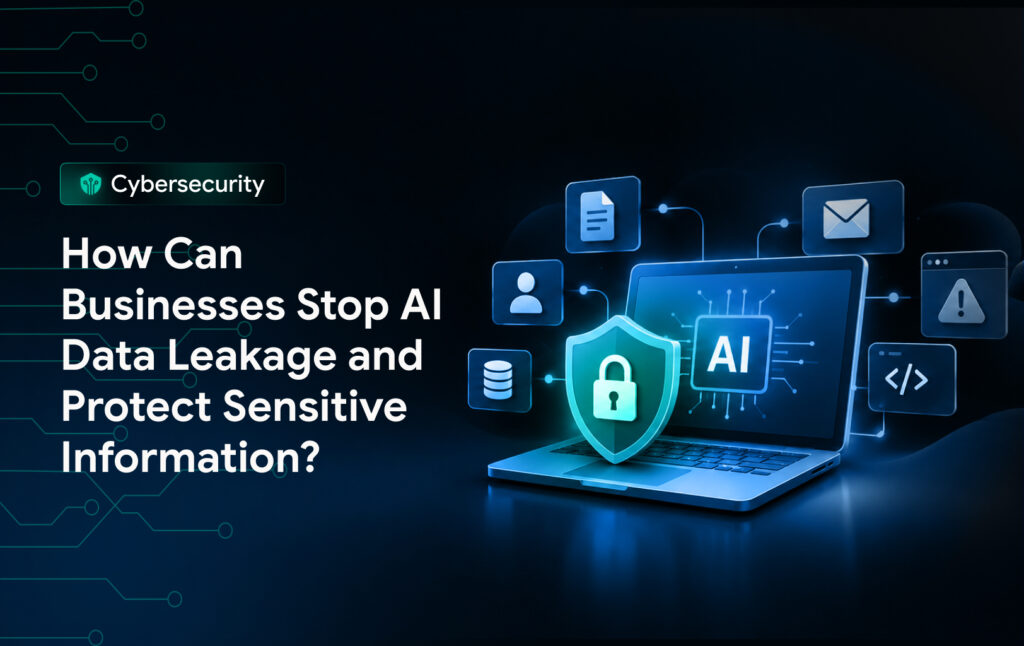
Artificial Intelligence (AI) has become an important part of everyday business operations. It supports customer service, sales, software development, data analysis and knowledge sharing. However, connecting AI systems with internal business data also introduces new security challenges.
One of the biggest concerns is how businesses can prevent AI data leakage, strengthen AI data security and protect confidential business information without slowing down innovation.
AI data leakage does not always result from major cyberattacks. Employees can also expose sensitive information through everyday activities. These include uploading confidential documents or using unauthorised AI tools.
AI systems may expose sensitive information when they access too much internal data or lack effective application security controls. This information may include personal details, login credentials, proprietary source code and confidential business documents. OWASP identifies Sensitive Information Disclosure as LLM02:2025 in its Top 10 for LLM Applications, highlighting the risks associated with sensitive data being exposed through AI applications.
This impact on business can be significant. According to IBM’s research, some companies had an AI-related security incident. Out of those 92% did not have the right controls to manage access to AI systems. In India, the average cost of a data breach went up to 255 million rupees in 2026.
The business impact of AI-related security incidents can be significant. IBM’s research highlights gaps in organisational preparedness, with 92%. In India, the average cost of a data breach reached 255 million rupees in 2026, according to IBM’s Cost of a Data Breach Report.
Traditional cybersecurity measures alone cannot address every AI-related risk. Businesses need a secure AI environment. This requires clear policies, controlled data access and effective data management. Regular security assessments, employee awareness and continuous monitoring are equally important to help organisations protect their information while using AI effectively.
Why Is AI Data Leakage a Growing Business Risk?
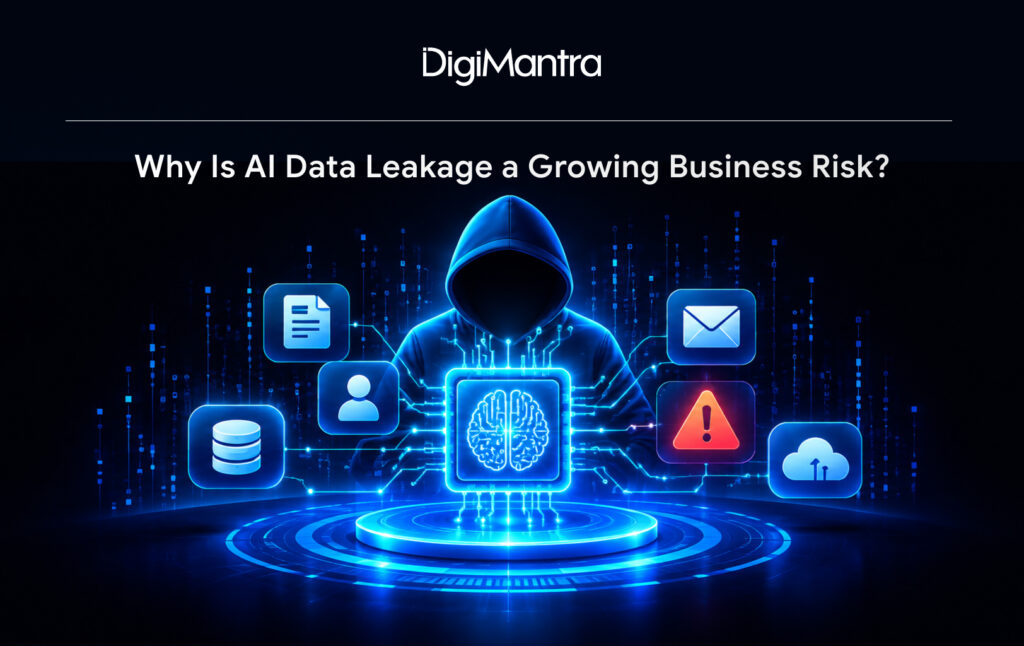
Traditional applications generally operate within predefined access and security boundaries. AI systems can interact with multiple data sources and connected services. A single workflow may involve user inputs, files, emails, databases, APIs and cloud services. This makes access management more complex.
If an AI assistant connected to company data has improperly configured permissions, it may retrieve information that a particular user is not authorised to access. Additionally, if an employee uses a public AI service, they may share company data outside of the organisation’s control without realising it.
Without proper AI security controls, sensitive business information can move beyond its intended access boundaries, increasing the risk of unauthorised data exposure.
AI-related security challenges are growing more complex. IBM’s 2026 Cost of a Data Breach Report highlights several security weaknesses. These include compromised APIs, vulnerable applications and misconfigured cloud settings. These problems usually do not result from flaws in the AI model itself.
Key Risk Factors Include:
- Exposure of sensitive information, including customer records, financial details, medical records, contracts and internal business documents.
- Unauthorised sharing of proprietary source code, business plans and confidential company processes.
- Excessive access permissions across AI tools, APIs and autonomous agents.
- Exposure of sensitive information through AI-generated responses, prompts, activity logs and connected applications.
- Security vulnerabilities arising from unapproved AI tools, commonly referred to as Shadow AI.
Where Can AI Data Leakage Happen in a Business?
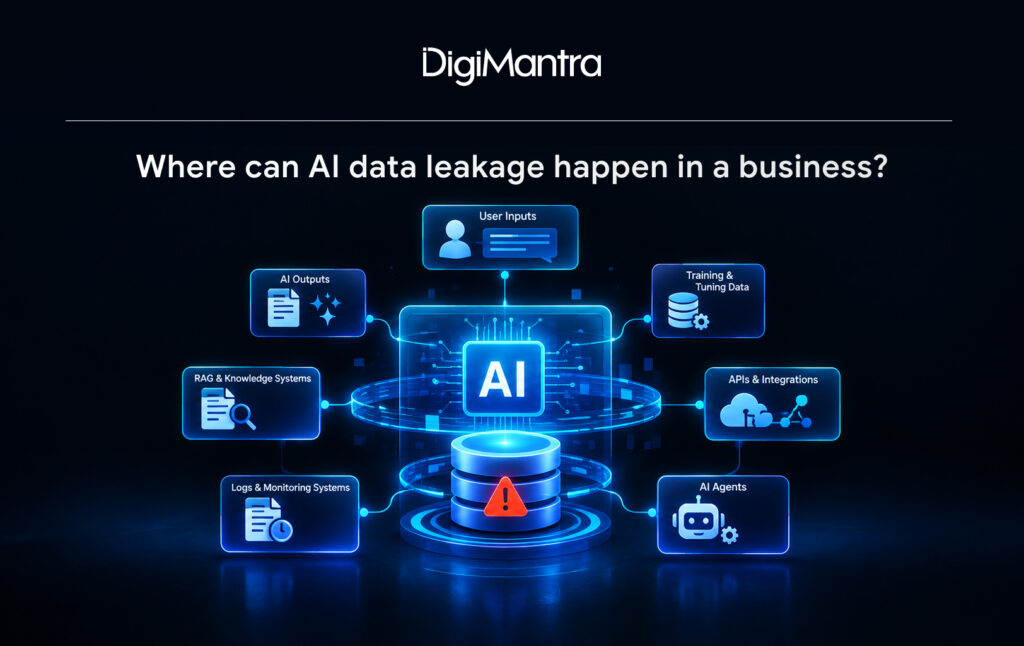
AI data leakage can occur at different stages of the AI development and deployment process. Just looking at the model is not enough because it can miss some security risks.
A company may use a secure AI model and still experience data leakage. An incorrectly configured database can expose information. Unnecessary API permissions, unsafe plugins and careless data sharing can also create risks.
Some Common Areas Where Data Leakage Can Happen Include:
- User Inputs: Employees might enter sensitive information, customer details, login details or company documents into AI tools.
- AI Outputs: AI systems may include sensitive information in their responses when they access confidential data without proper safeguards.
- Training and Tuning Data: Developers might add sensitive information to training datasets without proper checks or controls.
- RAG and Knowledge Systems: If access permissions are not configured correctly, documents might be accessed by people who should not have permission to view them.
- APIs and Integration: When systems are connected, they can create opportunities for data to be accessed or shared without proper authorisation.
- Logs and Monitoring Systems: Prompts, responses or activity logs generated by AI tools may contain sensitive information.
- AI Agents: Autonomous AI agents may be assigned overly broad permissions or credentials, allowing them to access business systems and sensitive information beyond what is required for their assigned tasks.
How Can Businesses Prevent AI Data Leakage?
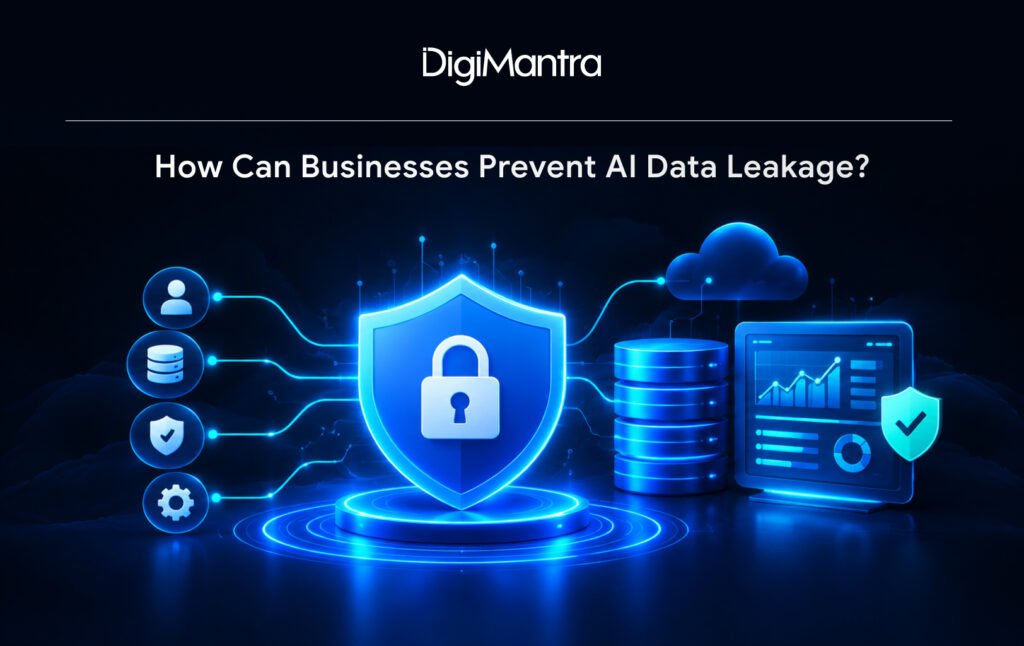 Preventing AI data leakage starts with treating AI as a part of the company’s overall security plan, not just as a tool that helps with work. Companies should establish rules about what information AI tools can access, where that information can be used, who is allowed to work with it and what the system is permitted to do.
Security measures need to be, in place before data is provided to the model and should also cover the stages where data is being processed and results are generated.
Key Strategies Include:
- Implement Data Classification Policies: Classify information before it is handled by AI systems to identify sensitive data and determine how it should be protected.
- Enforce Role-Based Access Controls: Use role-based access controls to ensure users and AI systems can access only the information they need.
- Use Data Masking and Redaction: Sanitise, redact, tokenise or mask sensitive data wherever necessary to prevent exposure.
- Apply the Principle of Least Privilege: Allow AI systems to access only the systems and datasets required to perform their tasks.
- Establish an Approved AI Tool Policy: Define which AI tools employees can use and establish clear rules for their use within the organisation.
- Monitor AI Data Access and Usage: Keep track of how AI interacts with data, how information moves between systems and which other tools are connected.
- Conduct Regular AI Security Testing: Test AI applications against prompt injection attempts and data extraction risks to identify potential vulnerabilities.
- Define AI Data Retention Policies: Set clear guidelines for how long data is retained, when it should be deleted and how vendors process and handle sensitive information.
Data Classification and Access Controls for Secure AI
One of the most important AI data security practices is ensuring that AI systems only access the information required to perform their assigned tasks. Not all AI projects require access to company databases, customer details or internal file collections. Giving an AI application access simply because it is possible can create additional security risks.
Instead, companies should classify data based on its sensitivity and create access rules accordingly.
Publicly available information may require fewer restrictions, while customer records, financial information, non-public source code, passwords and confidential company documents should have much stronger access controls.
Key Security Benefits of Data Classification and Access Controls:
- Least Privilege Access: This means AI systems are given the permissions they need to perform their assigned tasks. This helps reduce unnecessary access and improve security.
- Role-Based Controls: Users can only access the information permitted for their job roles, rather than automatically receiving the full access available to AI systems.
- Segmentation: Important databases and storage areas remain separate from AI activities that involve lower security risks.
- Reduced Blast Radius: If an AI application is compromised, limited access helps reduce the amount of data that could be exposed or stolen.
This is especially important as businesses adopt AI agents. According to IBM, AI agents act as non-human users that interact with applications, APIs, data and cloud services. This makes managing identities and permissions an important security challenge.
Protect RAG, Vector Databases and AI Integrations
Retrieval-Augmented Generation (RAG) is now widely used by businesses to connect AI with their knowledge resources. It helps make enterprise AI more useful without requiring all company information to be built directly into the model.
RAG also brings its own security challenges. The RAG system retrieves documents, processes them, converts them into embeddings and stores them before sending relevant information to the model. If permissions are not properly configured at the document level, a user might gain access to information simply because the AI system was able to retrieve it.
To secure RAG-based AI applications, businesses should enforce document-level access permissions, validate retrieved information against user access rights and protect vector databases through appropriate authentication and encryption. Regularly reviewing API permissions and monitoring data retrieval activities can also help prevent unauthorised access to sensitive information.
How Can Businesses Control Shadow AI?
Employees often start using AI tools before a company has established clear rules. They might use chatbots to summarise contracts, analyse spreadsheets, rewrite messages, create code or manage customer data.
Companies refer to this practice as “Shadow AI” when employees use AI tools without informing management or IT teams. The problem is not that employees use AI. The real concern is that security teams may not know which tools are being used, what information is being shared or how external platforms handle that data.
Uncontrolled use of AI tools can introduce additional security and data privacy risks, particularly when employees share confidential business information through unapproved platforms. A good, approved AI framework can offer several benefits:
- Approved AI Tool: A clear list of permitted AI tools and their approved uses.
- Data Handling Rules: Guidelines for managing customer, employee, financial and company data.
- External AI Controls: Controls for external AI services and web-based applications.
- Employee Training: Training of employees on how to use AI safely and understand common security risks.
- Better Visibility: Improved insight into how AI is being used across different parts of the company.
These policies help employees use AI responsibly while reducing the risk of sensitive business information being exposed through unapproved tools.
Build AI Governance into Every Stage of the AI Lifecycle
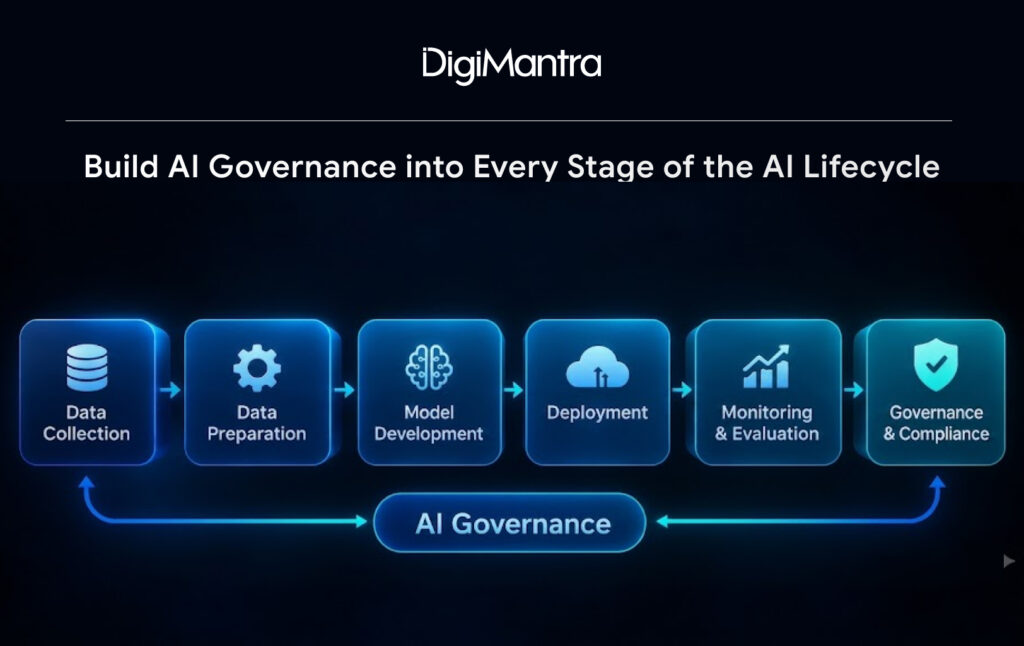
AI security is most effective when it is part of the AI development process from the start. Teams should build security into the system before deployment, rather than adding it later.
Before an AI system is launched, a business needs to determine what data it will use. It must also assess potential risks and decide who will oversee each part of the system. Businesses must establish clear security rules.
Once the AI system starts operating, teams must put those rules into practice through access controls, monitoring and regular testing.
Organisations should continue reviewing and updating security controls throughout the AI system’s lifecycle. That is because models can evolve, integrations and connections can change, data sources can be updated and the way people use AI can change over time.
Business Benefits of an AI Governance Framework:
- Accountability: Defines responsibility for AI systems, data handling and security controls.
- Cross-Team Alignment: Ensures business, IT and security teams follow consistent AI governance practices.
- Compliance Readiness: Helps businesses prepare for applicable privacy and security requirements.
- Proactive Risk Management: Identifies potential security and data privacy risks before deploying AI systems.
- Ongoing Security Oversight: Supports continuous review of AI systems, integrations and evolving security requirements.
AI governance is more than just a policy document. It becomes the framework that brings together security, data handling, access controls and the responsible use of AI.
Conclusion
Businesses adopting Artificial Intelligence must make data security a priority. As AI systems become increasingly connected to business documents, databases, APIs and enterprise applications, protecting sensitive information requires more than traditional cybersecurity measures.
Preventing AI data leakage requires a combination of data classification, access controls, secure integrations, employee awareness and continuous monitoring. Businesses must also address emerging risks associated with AI agents, prompt injection, insecure APIs and unauthorised data retrieval.
A well-defined AI data security strategy helps organisations reduce exposure risks, maintain control over sensitive information and adopt AI with greater confidence.
Looking to adopt AI without compromising data security? Connect with DigiMantra to explore secure AI solutions and responsible AI implementation strategies.
Frequently Asked Questions:

AI-FIRST ENGINEERING FOR MODERN BUSINESSES
Designed for performance. Powered by innovation.
 Product Development
- Custom Software
 Mobile & Web
- AI & Automation
- Cloud Management
- Intelligent Systems