

Artificial intelligence is changing how businesses operate, make decisions and deliver services. From automating repetitive tasks and processing data to improving customer relationships, AI is creating new opportunities for organisations across industries.
However, implementing AI technologies does not guarantee improved organisational performance. Many companies have invested in AI tools, applications and implementation initiatives, but are unsure whether these systems have worked as planned and improved their operations.
The main task now is not just to introduce AI into organisations, but also to understand how to use it effectively. Companies should move beyond trial and error and apply artificial intelligence technologies to specific operational challenges. To do this, they must identify their objectives, AI use cases, methods of technology integration and performance measures beforehand.
A good artificial intelligence strategy connects technology investments to measurable AI business value. Whether organisations want to boost employee productivity, improve workflow efficiency, enhance customer satisfaction or make better decisions, they should determine how much their AI activities contribute to overall business performance.
In this blog, we will discuss how companies can progress beyond AI implementation, evaluate its real impact on business performance and create an AI strategy that delivers long-term business benefits.
Why Is AI Adoption Alone Not Enough to Deliver Business Value?
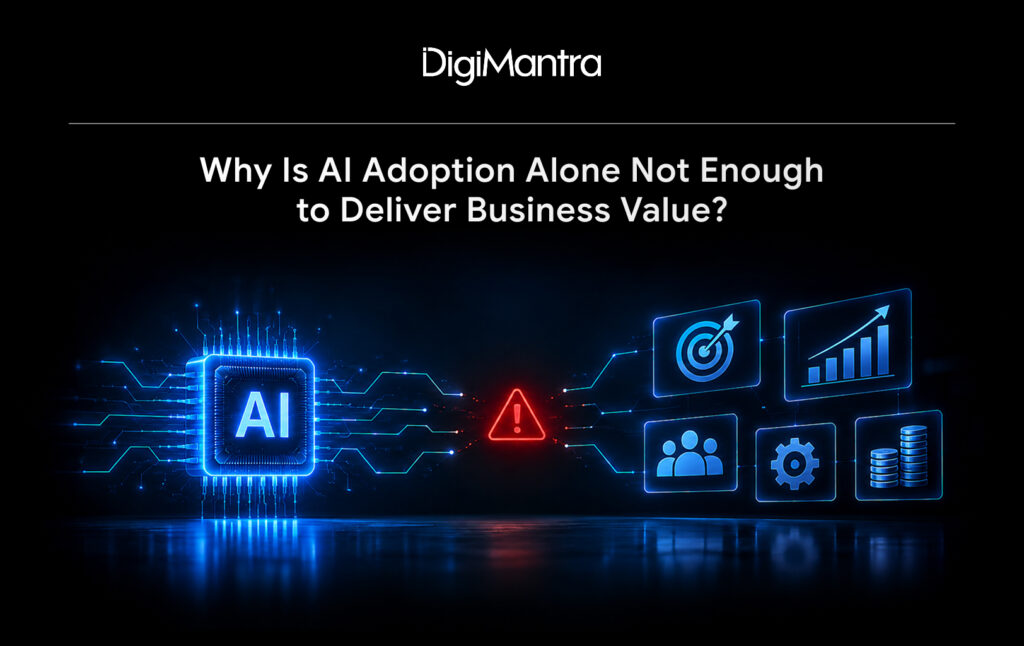
Adopting AI technology is a step towards digital transformation but simply implementing it does not guarantee business improvement. Many organisations introduce AI-based technologies without clearly identifying the business problems they want to solve.
As a result, AI systems may remain underused, employees may struggle to integrate them into their daily work, and businesses may find it difficult to measure their actual impact.
For example, an AI-powered chatbot can reduce the need to handle customer queries manually. However, this does not automatically mean customers will receive faster responses or need fewer interactions with human support teams.
The real difference between simply using AI and transforming business operations with it comes down to how effectively the technology improves everyday processes.
Some common reasons why AI adoption fails to deliver expected business value include:
- Undefined Business Objectives: Many companies use AI without first figuring out what they want to achieve or what success looks like.
- Difficulty in Measuring ROI: It is hard for organisations to see how AI spending leads to real improvements in operations or financial results.
- Disconnected Work Processes: AI tools operate separately from other systems, adding to manual effort.
- Poor Data Quality: Insufficient or poor-quality data can prevent AI from working well and reduce the value of its insights.
- Absence of Performance Measurement: AI tools are put in place without checks on how well they work.
To overcome these barriers, businesses must treat AI as a business investment, not just a technology upgrade.
How Can Businesses Turn AI Adoption into Measurable AI Business Value?
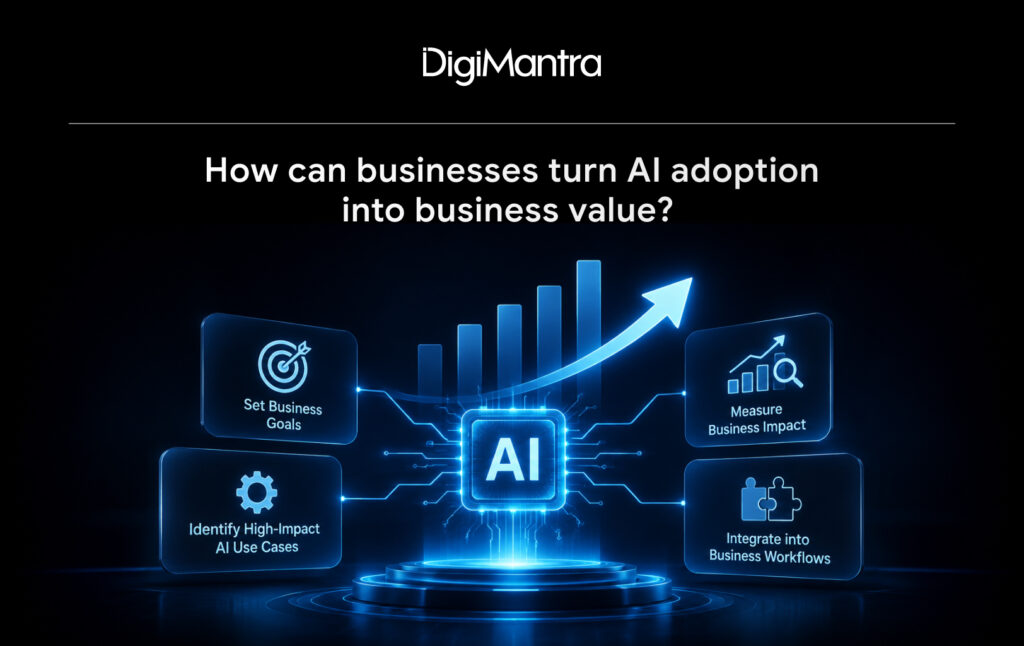
To achieve business value from the implementation of artificial intelligence solutions, it is crucial to develop a systematic approach that integrates AI capabilities with business objectives. Businesses should identify areas where AI can provide the most support, define their use cases accordingly and monitor the outcomes.
Here are practical tactics businesses should use:
1. Create business objectives before AI implementation
The first step towards gaining business value from AI is to identify the goals the organisation wants to achieve. Instead of installing AI just to follow a trend, companies must identify operational problems where AI can make a significant difference.
For example, a retail company might use AI-driven demand forecasting to improve inventory management. A financial services company could automate document processing to reduce manual work. A healthcare provider could use AI to streamline administrative tasks. A technology company could use AI-based software testing to increase development output. A customer support division could use automation to handle queries more effectively.
Every AI solution should support a specific business goal.
What should be considered prior to implementing AI?
- Identify existing operational problems.
- Define the processes that consume too much time and resources.
- What do you want to achieve?
- Do you have enough data and the required infrastructure?
2. Identify High-Impact Applications of Artificial Intelligence
Not every business process requires artificial intelligence, as some processes can be performed satisfactorily using conventional software or rule-based automation.
Companies should identify the areas where artificial intelligence can create additional value through intelligent data analysis, pattern recognition, forecasting, content generation and decision-making.
Business functions where companies can implement useful AI applications include:
- Customer Experience: Implementing chatbots, recommendation engines and efficient customer support.
- Sales and Marketing: Scoring leads, studying consumer behaviour and generating predictive sales insights.
- Business Operations: Automating workflows, processing documents and managing tasks.
- Finance: Forecasting financial performance, detecting anomalies and preparing automated reports.
- Data Analytics: Using predictive analytics and business intelligence, and monitoring performance in real time.
- Software Development: Using AI-based coding, automating testing and optimising development processes.
This allows companies to identify AI applications that can deliver measurable results.
3. Evaluate AI ROI Through Relevant Business KPIs
Evaluating whether AI-driven technology delivers the expected return on investment (ROI) is an important part of business transformation. Before implementing AI solutions, a business must set key performance indicators (KPIs) to evaluate performance, identify areas for improvement and assess the effectiveness of its investments. Rather than focusing only on how many employees use AI tools, businesses must focus on measurable results that demonstrate value.
Key performance indicators for evaluating AI business performance include:
- ROI: This refers to the profit or loss relative to the amount invested in AI technology.
- Reduction in operational costs: This indicates the reduction in costs resulting from business process automation.
- Employee efficiency: This refers to improvements in employee productivity and job performance, and reductions in the time spent on repetitive tasks.
- Time to complete business processes: This measures how quickly business activities are completed with the help of AI technology.
- Customer satisfaction: This measures improvements in the customer experience, including the efficiency and quality of responses from the customer’s perspective.
- Reduction in errors: This shows reductions in data-entry, processing and operational errors.
- AI implementation rate: This indicates how effectively staff members use AI technology in their day-to-day activities.
KPIs should be selected based on the goals of each AI deployment. For example, measuring customer satisfaction, problem resolution and escalation rates may be more useful for evaluating AI customer service performance than measuring the number of conversations.
This helps companies understand the AI business value delivered through improved performance and operational efficiency.
4. Ensure AI Is Incorporated into Established Business Processes
AI delivers greater value when integrated into everyday business activities rather than used as a standalone tool. Disconnected AI systems can increase employees’ workloads by requiring manual data transfers. Companies should aim to connect AI tools with their existing software, servers, CRM and ERP systems, and other business applications.
The most important areas of AI workflow integration includes CRMs, ERPs, data stores and BI systems; cloud applications; customer service and communication tools; internal reporting and workflow management systems; and business process automation systems. Successful integration can help a company reduce disconnected operations, improve data sharing and use AI tools within its existing IT systems.
How Businesses Can Build AI Solutions That Deliver Measurable Value
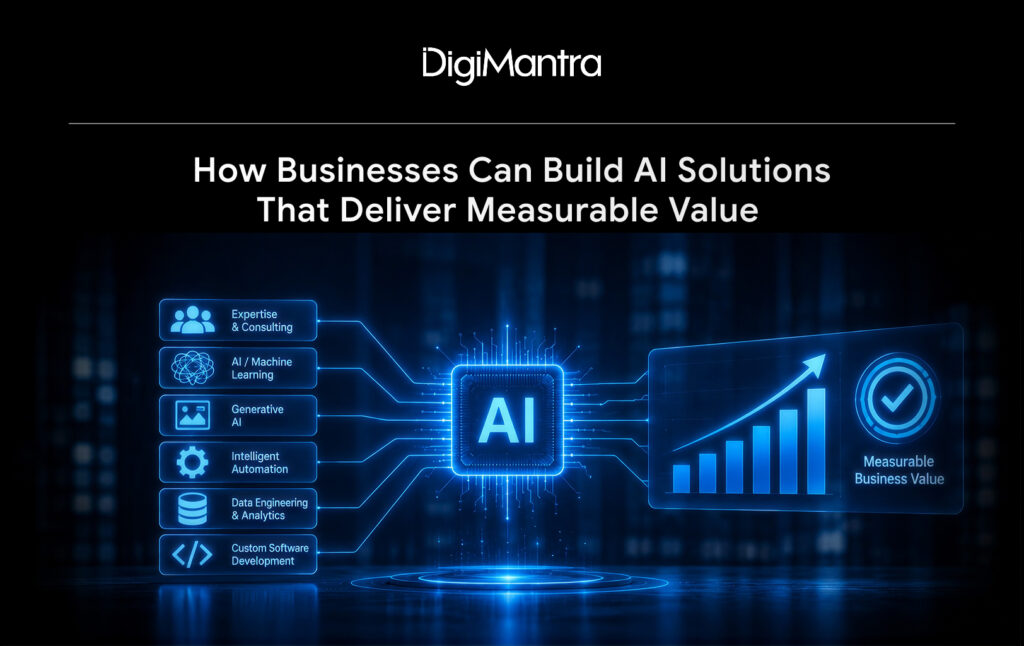
To gain measurable benefits from AI, advanced technology alone is not enough. Businesses need the right mix of people, AI expertise, reliable data infrastructure and knowledge of business processes. Effective AI implementation must address specific business tasks and support further investment.
The following areas should be considered:
- AI Implementation & Consulting: Identifying processes that AI can improve and carefully planning its implementation.
- AI and Machine Learning: Using models to analyse data, identify trends, make predictions and support informed decisions.
- Generative AI: Using AI-powered tools to find information, generate content and handle data more easily.
- Intelligent Automation: Adding AI to repetitive tasks to reduce manual work and boost performance.
- Data Engineering & Analytics: Building data systems that make information easy to access and use.
- Custom Software Development: Designing software that includes AI features and integrates smoothly with existing business systems.
Conclusion
In conclusion, AI gives businesses opportunities to boost productivity, improve their operations and make better decisions. However, the real AI business value lies in delivering measurable business results. To go beyond simply using AI, businesses must first define their objectives, choose suitable use cases, integrate AI into daily work and monitor the results. AI can then change the way a business operates.
Moreover, businesses should invest time in preparing employees for AI adoption, ensuring data quality, governing its use and building a strong technology foundation. A good AI plan will help businesses improve their operations, serve customers better and create opportunities for growth. The success of AI transformation will depend on how effectively companies use AI tools, not on how many tools they adopt.
Frequently Asked Questions

AI-FIRST ENGINEERING FOR MODERN BUSINESSES
Designed for performance. Powered by innovation.
 Product Development
- Custom Software
 Mobile & Web
- AI & Automation
- Cloud Management
- Intelligent Systems