

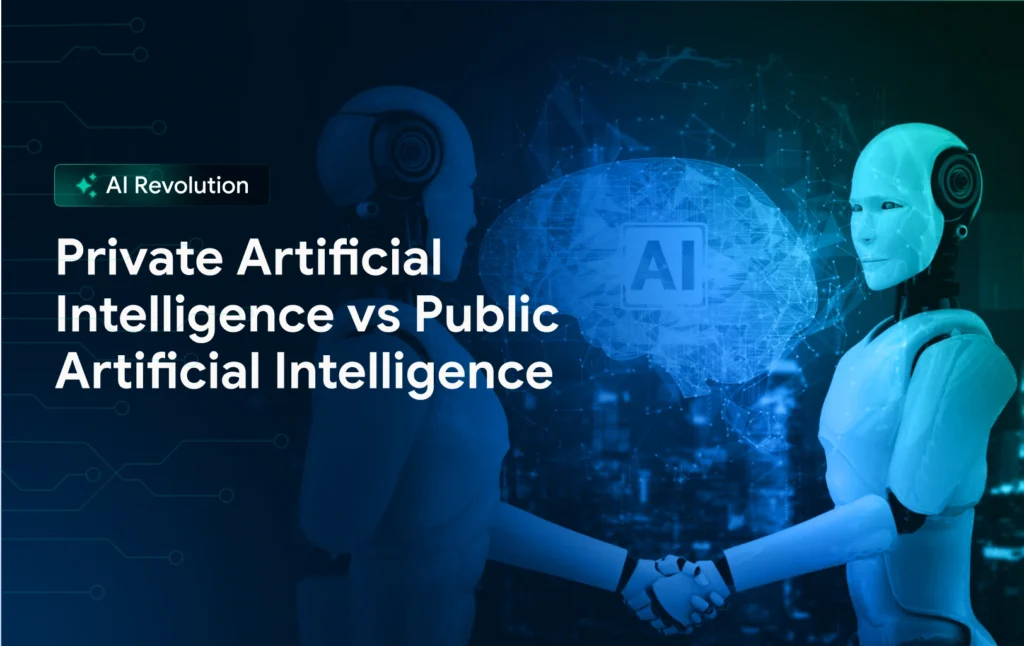
In the race to invest in the best AI for businesses, organisations compare the advantages and disadvantages of Private Artificial Intelligence and Public Artificial Intelligence. Both have their strong and weak sides regarding security, compliance, costs, scalability, and customisation.
AI Adoption Is on the Rise: Where Should Your AI Be Deployed?
Artificial intelligence is no longer a novelty; businesses are adopting various AI models to automate processes, improve customer experience, increase the speed of software development, and make more accurate data-driven decisions.
However, as more and more companies turn to AI to get an edge, an additional dilemma emerges concerning the model’s deployment and control over it. Some organisations go for cloud-based mechanisms, which are quick and convenient, while others, especially the ones operating in highly regulated environments and handling massive amounts of data, opt for on-premise solutions for greater control over infrastructure and data.
Such AI strategies have an impact not only on the infrastructure layer but also on security, compliance, costs, and long-term AI strategy.
We present a comparison of the two strategies and discuss the advantages and limitations of Private AI and Public AI to help you choose the one best fitting your organisation.
Why Your AI Deployment Strategy Matters More Than Ever
An organisation’s choices about which AI to adopt, how and where to deploy it, and how to scale it up or down have an impact on its ability to fully benefit from AI. This is why having a well-thought-out AI strategy, supported by Generative AI Development Services, plays such an important role in any company’s decision-making. These services help businesses design, implement, and optimise AI solutions that align with their goals, ensuring greater efficiency, scalability, and long-term value.
A properly organised AI strategy will serve as a reliable foundation for launching and scaling AI initiatives in the organisation and help navigate the most critical areas: ensuring security and compliance, getting the most value for the investments made, and being able to scale AI solutions in a responsible and sustainable way.
Meanwhile, the wrong deployment strategy will generate security and compliance risks, unnecessary complexity, and limitations for future AI growth.
The significance of such strategies will continue to grow, given the increasing importance of AI for business operations; hence, the need for developing them with due care and attention to detail is paramount.
Understanding Public AI
Public AI is AI software that is designed and maintained by a third party. It is available to the general public and can be accessed via the web or other means of communication without the need for companies to configure the underlying infrastructure.
Among the most popular examples of Public AI are ChatGPT, Google Gemini, Anthropic Claude, and Microsoft Copilot.
Businesses are quick to embrace Public AI because of its many advantages, including rapid deployment, low capital expenditures, and the ability to innovate and experiment.
Public AI Advantages
- Easy and rapid deployment with minimum effort and infrastructure investment
- Lower initial costs
- Receiving automatic model updates
- No need to maintain and manage infrastructure
- An excellent option for experimentation with new concepts
- Bringing products to market faster
Public AI Limitations
- The level of protection of customer data and the length of its storage on third-party servers may be of concern
- There may be issues with adherence to certain regulations and standards
- The danger of getting used to a single supplier
- The degree of protection of confidential information and the ability to customise the system to specific needs may be limited
- The degree of control over infrastructure and management processes may be low
- Limited support for internal governance policies may be an issue
For organisations that store personal customer data or valuable intellectual property on their servers, using Public AI may raise security and regulatory concerns, which must be carefully considered before using this type of AI in critical business processes.
Understanding Private AI
Unlike Public AI, Private AI runs in an isolated environment under the full control of the organisation using it. It can be installed on company servers, in a private cloud, or on a Virtual Private Cloud (VPC).
With Private AI, an organisation has full control over its data, AI models, and infrastructure, as well as the ability to fine-tune security, management, and governance policies.
Private AI is often the preferred choice for organisations that want to ensure the highest level of security and compliance and/or have highly specialised and unique models that require a separate environment for proper functioning.
Private AI Advantages
- Full control and ownership of data
- Enhanced data security
- Compliance with regulatory standards
- Tailored and optimised AI models
- Greater flexibility in integrating with other systems and infrastructure
- Reduced dependency on third-party suppliers
While deploying Private AI requires a larger initial investment, for many companies, the reduced costs associated with long-term use and the ability to scale AI solutions more efficiently makes it a viable option.
Choose Public AI if you want to get started quickly
Public AI is perfect for rapid, low-cost experimentation and deployment of AI-driven solutions without the need to invest time and effort in maintaining and operating the underlying infrastructure.
Choose Private AI if you want more control
Private AI is the way to go if you want greater security and governance, as well as the ability to develop and deploy unique AI models customised to your specific needs.
Choose Hybrid AI if you need both
With Hybrid AI, you get to enjoy the advantages of both Public and Private AI, using each in the appropriate place.
When to Use Public AI?
Public AI is appropriate in use cases where speed, flexibility, and cost-effectiveness are more important than security and compliance. Some of the most common applications of Public AI include content creation, marketing automation, chatbots, software development, productivity, and experimentation.
The choice of Public AI is driven by the desire to achieve speed and cost advantages while experimenting with AI.
Who Should Choose Public AI?
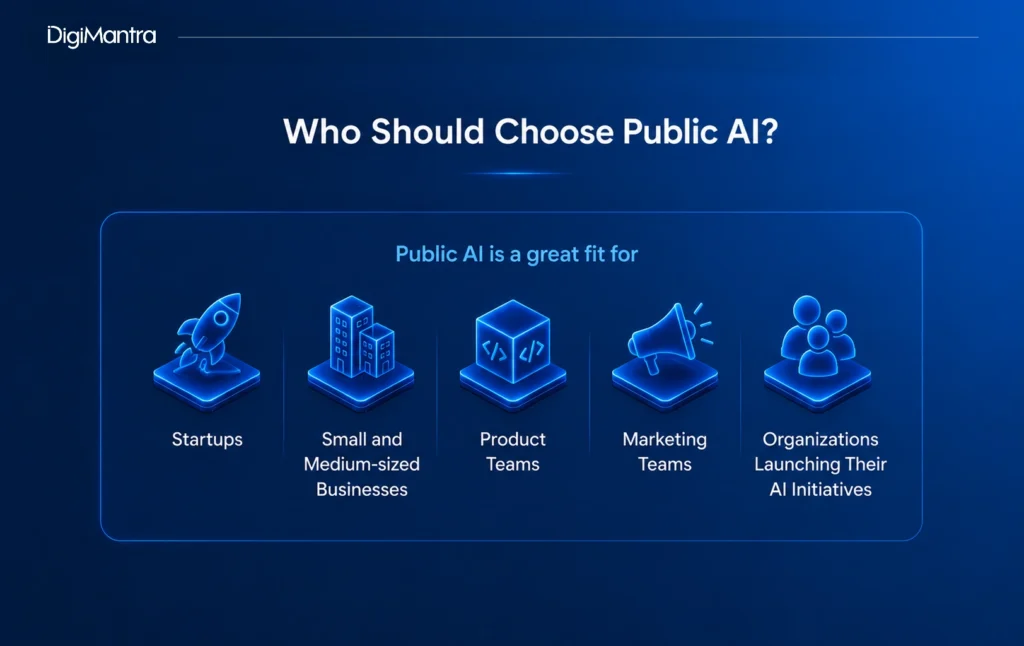
Public AI is a great fit for startups, small and medium-sized businesses, product teams, marketing teams, and organisations launching their AI initiatives.
When to Use Private AI?
Private AI is usually the preferred choice in use cases where security, compliance, customisation, and governance are key selection criteria. Some of the most common applications of Private AI include knowledge assistants, enterprise document intelligence, AI-driven compliance systems, finance, healthcare, and secure Retrieval-Augmented Generation (RAG).
Who Should Choose Private AI?
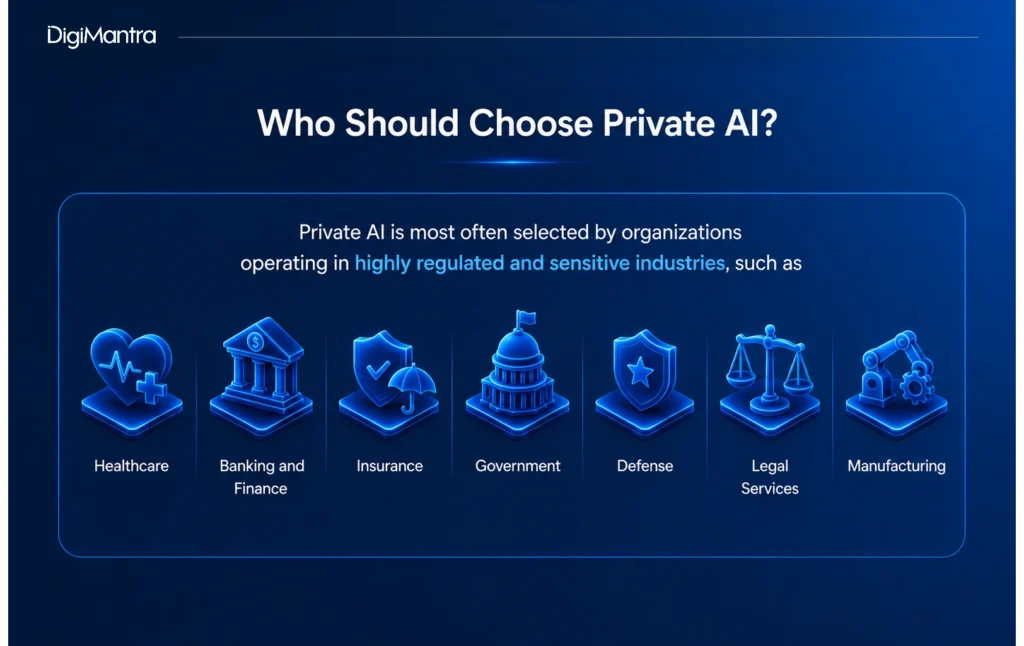
Private AI is most often selected by organisations operating in highly regulated and sensitive industries, such as healthcare, banking and finance, insurance, government, defense, legal services, and manufacturing.
Hybrid AI: The Best of Both Worlds
The choice between Public and Private AI is not always entirely clear-cut, as it depends on a variety of factors, including the use case, data sensitivity, infrastructure readiness, customisation needs, and budget constraints. However, for some organisations, the choice between the two is obvious: in their operations, they need to use both Public and Private AI, which serve different purposes.
This is the reason why some companies are turning to Hybrid AI, which combines the advantages of both.
A Hybrid AI strategy allows you to
- benefit from the cost-effectiveness and convenience of Public AI,
- leverage the security and control of Private AI,
- balance the need for modernisation with security and control,
- optimise infrastructure costs,
- and achieve greater flexibility.
Hybrid AI infrastructures are growing in popularity among enterprises as a way to harness the latest breakthroughs in AI while keeping mission-critical business data protected.
Questions Every Enterprise Should Ask Itself When Choosing Between Public and Private AI
When selecting the preferred AI infrastructure type, organisations should answer the following questions.
Security:
- Is the AI processing confidential customer data?
- Will employees access sensitive internal information?
Compliance:
- Are there any GDPR, HIPAA, SOC 2, PCI-DSS, or other regulatory requirements?
Infrastructure:
- Do you have an existing cloud/on-premise infrastructure?
- Are you able and willing to manage AI infrastructure internally?
Customisation:
- Do you need industry-specific AI models?
- Will you need to integrate AI with proprietary systems?
- Do you plan on using RAG or AI agents?
Budget:
- Is your organisation willing and able to make the necessary long-term infrastructure investments?
- Will a subscription-based AI model better suit your organisation’s needs?
Common Mistakes When Using AI
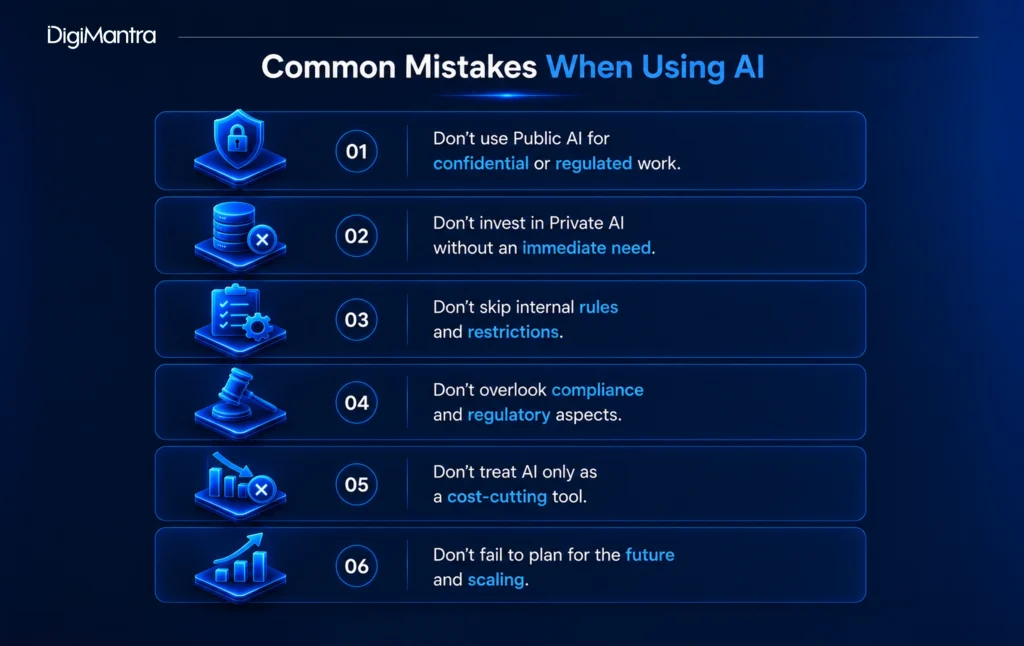
In most cases, AI initiatives fail not because the models were ineffective but because the organisations did not use them properly. To avoid the most common pitfalls, remember the following guidelines.
- Do not use Public AI for highly confidential or regulated procedures.
- Do not invest heavily in Private AI if you have no immediate need for it.
- Do not neglect to establish internal rules and restrictions for using AI.
- Do not underestimate the importance of regulatory and compliance-related aspects.
- Do not fall into the trap of viewing AI as a means of reducing costs; instead, focus on finding ways to get the most out of it.
- Do not fail to plan for the future and consider the need to scale AI solutions.
Key Takeaways
Public and Private AI have different advantages and disadvantages; organisations must carefully weigh these before making a choice.
Public AI enables businesses to adopt and experiment with AI rapidly but involves substantial long-term costs. In contrast, Private AI offers increased control, security, and customisation but requires a significant initial investment. The combination of the two, known as Hybrid AI, is becoming an increasingly popular choice for enterprises.
The right infrastructure type depends on an organisation’s specific needs, including data sensitivity, regulatory requirements, and infrastructure investment capabilities. Finally, choosing the most suitable AI infrastructure is essential for ensuring the smooth and secure operation of AI systems.

AI-FIRST ENGINEERING FOR MODERN BUSINESSES
Designed for performance. Powered by innovation.
 Product Development
- Custom Software
 Mobile & Web
- AI & Automation
- Cloud Management
- Intelligent Systems