

Retrieval-Augmented Generation (RAG) has quickly become a go-to approach in modern AI development. Instead of relying only on what a language model learned during training, RAG allows it to fetch information from external sources like documents, databases, and enterprise knowledge bases while generating responses. The result is AI that doesn’t just guess; it responds with answers that are more accurate, relevant, and grounded in real-world data.
Despite its strengths, traditional RAG systems come with a notable limitation. In most cases, the system retrieves information before it truly understands what knowledge is required. It starts by searching for documents that appear similar to the user’s query and only afterward tries to interpret and reason with the retrieved content. While this approach works reasonably well for straightforward questions, it can struggle when queries involve deeper analysis, comparisons, or multi-step reasoning.
In fact, studies show that while traditional RAG can reduce hallucinations by up to 50% compared to standard LLM outputs, nearly 70% of errors in complex multi-step queries arise from retrieving irrelevant or loosely related documents, highlighting the need for a reasoning-first approach.
This is where Cognitive Retrieval-Augmented Generation (Cog-RAG) enters the picture. Instead of jumping straight into retrieval, Cog-RAG adds an initial reasoning layer. The system first examines the query, breaks down what the user is actually asking, and identifies the type of information needed. Only then does it retrieve relevant knowledge. By introducing this extra step, Cog-RAG enables RAG systems to approach problems more thoughtfully, essentially allowing them to think before they retrieve.
The Rise of Retrieval-Augmented Generation
To understand why Cog-RAG (Cognitive Retrieval-Augmented Generation) matters, it’s helpful to briefly revisit why RAG became so important in the first place. Early language models relied entirely on knowledge learned during training. This meant that once the model was trained, its knowledge remained static. It could not access updated information or proprietary data stored within organisations. This limitation has driven growing demand for AI and ML Development Services, which leverage advanced retrieval techniques like RAG to build intelligent applications capable of accessing accurate, up-to-date, and organisation-specific knowledge in real time.
RAG solved this limitation by connecting language models with external data repositories. Instead of answering questions purely from memory, the system could fetch relevant documents and incorporate them into the response generation process.
This approach delivered several important advantages:
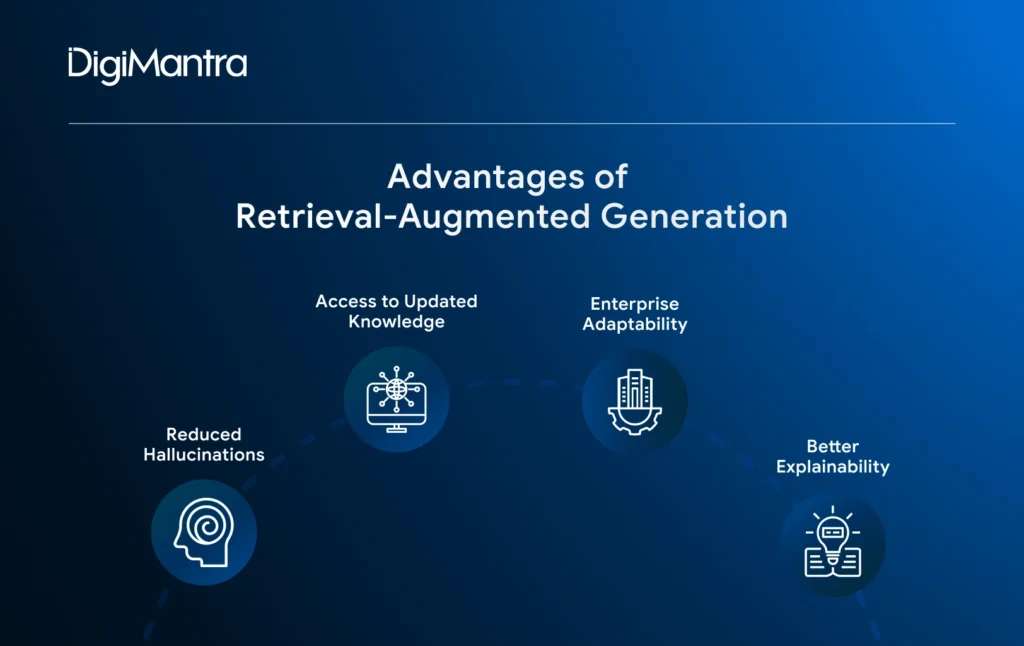
- Reduced hallucinations: Responses are backed by retrieved documents.
- Access to updated knowledge: Systems can reference newly added data.
- Enterprise adaptability: Companies can integrate internal knowledge bases.
- Better explainability: Answers can cite specific sources.
Because of these benefits, RAG architecture quickly became the default for many AI-powered knowledge systems. Yet the retrieval-first design introduced a new challenge: the system often retrieves too much or the wrong information.
Where Traditional RAG Starts to Struggle
Traditional RAG works exceptionally well for straightforward questions. If a user asks something like “What are the benefits of cloud computing?”, the system can retrieve appropriate documents and produce a well-structured answer.
The challenge arises when queries require structured reasoning or multi-step analysis. Take, for example, a question like:
“How do the architectural designs of two blockchain platforms affect their expansion potential and transaction processing capacity?”
- This question contains several layers:
- Understanding each platform’s architecture.
- Identifying scalability mechanisms.
- Comparing transaction performance.
- Drawing conclusions from multiple sources.
A conventional RAG system typically performs a single retrieval step based on semantic similarity. It might retrieve documents mentioning blockchain scalability, but fail to organise the information logically. As a result, the model receives a mixture of partially relevant content and must attempt to synthesise an answer from it.
Common issues in traditional RAG include:
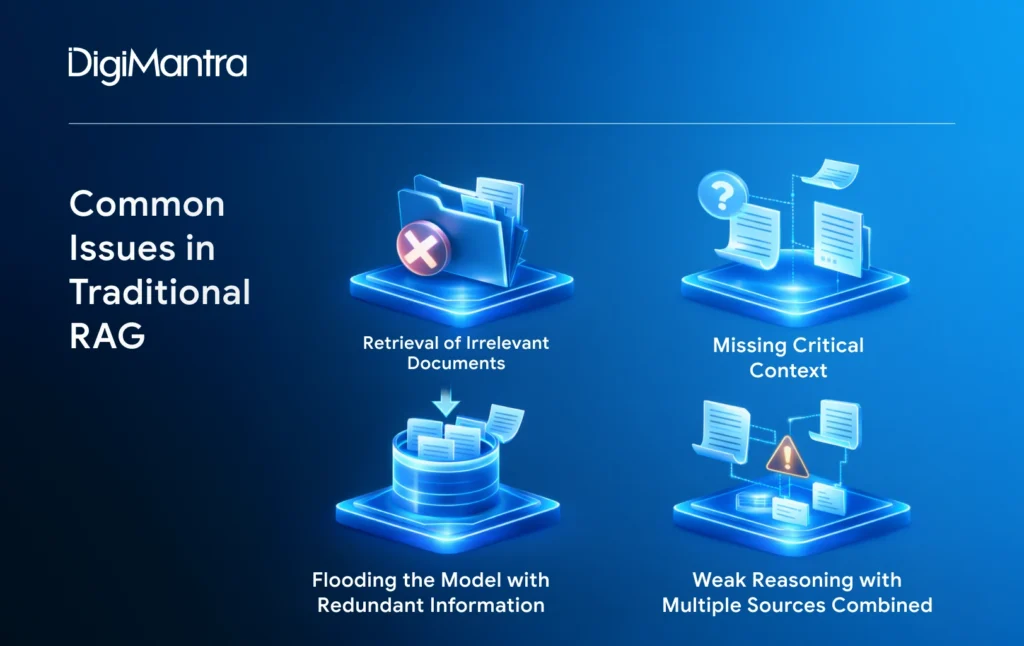
- Retrieval of irrelevant documents.
- Missing critical context.
- Flooding the model with redundant information
- Weak reasoning when multiple sources must be combined.
These limitations of RAG systems highlight the need for a more thoughtful retrieval strategy.
What is Cog-RAG?
Cog-RAG introduces a deceptively simple improvement: the system thinks before it retrieves. Instead of immediately searching for documents, the model first analyses the user’s query. It attempts to understand the problem and determine what knowledge is required to solve it. Only after this reasoning phase does the retrieval process begin.
This approach mirrors how humans typically solve complex problems. When someone asks a difficult question, we rarely start gathering information instantly. Instead, we pause to analyse the question, break it down into parts, and decide what sources might help answer it.
Cog-RAG brings that same pattern into AI workflows. The reasoning-based retrieval in AI allows the system to:
- Interpret the intent behind the query.
- Break the problem into smaller sub-questions.
- Identify knowledge gaps.
- Plan targeted retrieval steps.
By the time retrieval occurs, the system already has a roadmap for what it is trying to find.
How Cog-RAG Works: A Smarter Retrieval Workflow
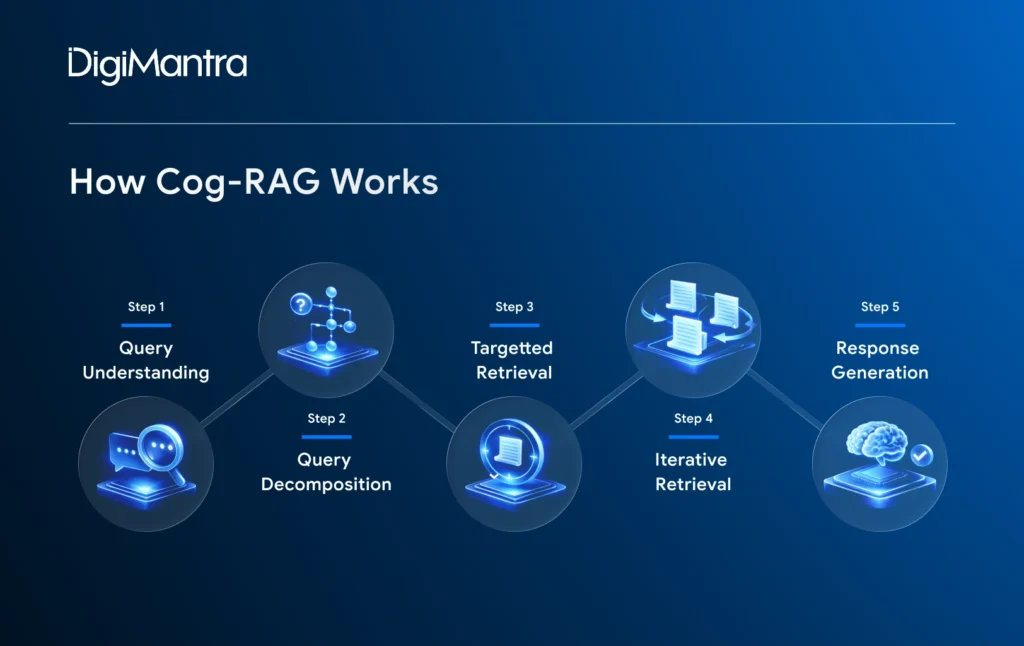
Cog-RAG expands the traditional RAG pipeline into a more structured workflow that blends reasoning and retrieval. Instead of one retrieval step followed by generation, the system moves through multiple stages:
1. Query Understanding
The system first analyses the user’s request to determine the type of reasoning required. It identifies key entities, relationships, and the overall intent of the query. For example, the model might recognise whether the user is asking for:
- A comparison
- A causal explanation
- A step-by-step process
- A summary of multiple sources
Understanding this intent helps guide later retrieval steps.
2. Query Decomposition
Complex questions are broken into smaller tasks. This decomposition makes it easier for the system to retrieve information that directly supports each reasoning step. For instance, a comparison query might be decomposed into:
- Understanding system A
- Understanding system B
- Identifying differences
- Evaluating performance outcomes
Each step becomes a focused retrieval task rather than one broad search.
3. Targeted Retrieval
Once the system has a reasoning plan, it begins retrieving information. Instead of searching based solely on the original query, it performs targeted searches for each sub-task. This improves relevance and prevents the model from receiving large amounts of unnecessary context.
The result is cleaner, more focused knowledge input for the language model.
4. Iterative Retrieval
Sometimes, the first round of AI retrieval architecture reveals missing information. Cog-RAG systems can perform additional retrieval cycles to fill these gaps.
This iterative approach mimics the way researchers refine their search strategies when exploring complex topics. Instead of relying on a single search result, the system progressively improves its understanding.
5. Response Generation
After gathering the necessary knowledge, the model synthesises the information into a coherent response. Because the retrieval process was guided by reasoning, the final answer tends to be more structured, accurate, and relevant.
Why Cog-RAG Matters for Enterprise AI
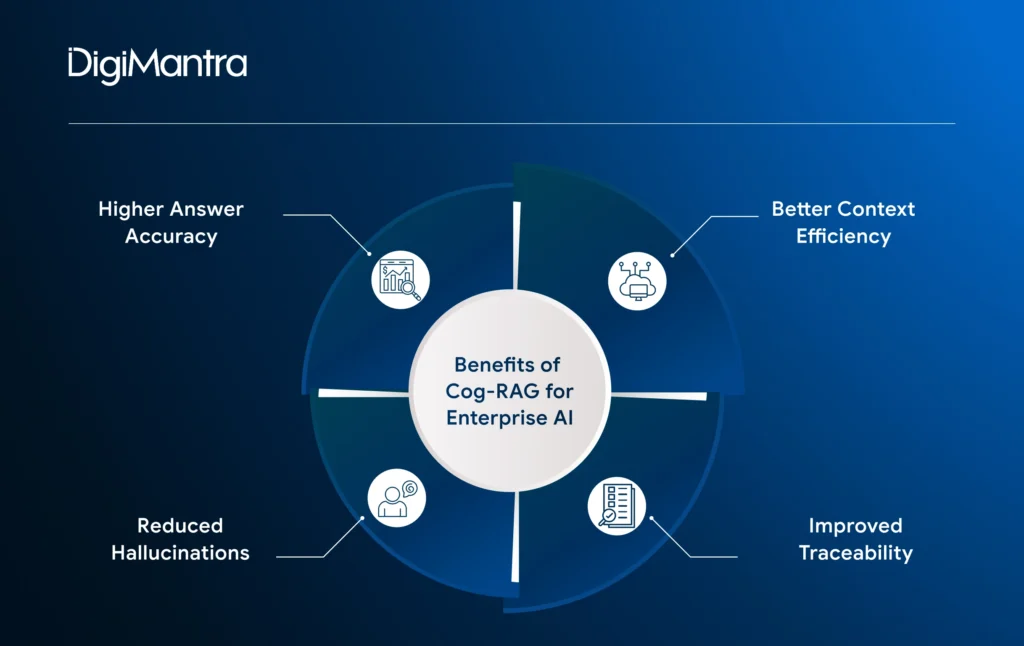
For organisations deploying AI across large knowledge environments, Cog-RAG offers several practical advantages. Enterprises often store information across many platforms – documentation systems, CRM tools, product manuals, engineering notes, and support archives. Navigating this fragmented landscape can be difficult for traditional retrieval systems.
Cog-RAG improves performance by making retrieval more intentional. Instead of pulling dozens of loosely related documents, the AI knowledge retrieval systems fetch smaller sets of highly relevant information aligned with the reasoning plan.
This leads to several benefits:
- Higher answer accuracy because irrelevant documents are minimised.
- Reduced hallucinations due to stronger knowledge grounding.
- Better context efficiency, which improves model performance.
- Improved traceability for enterprise compliance and auditing.
For AI copilots that assist employees or customers, these improvements can significantly enhance reliability and trust.
Real-World Applications of Cog-RAG
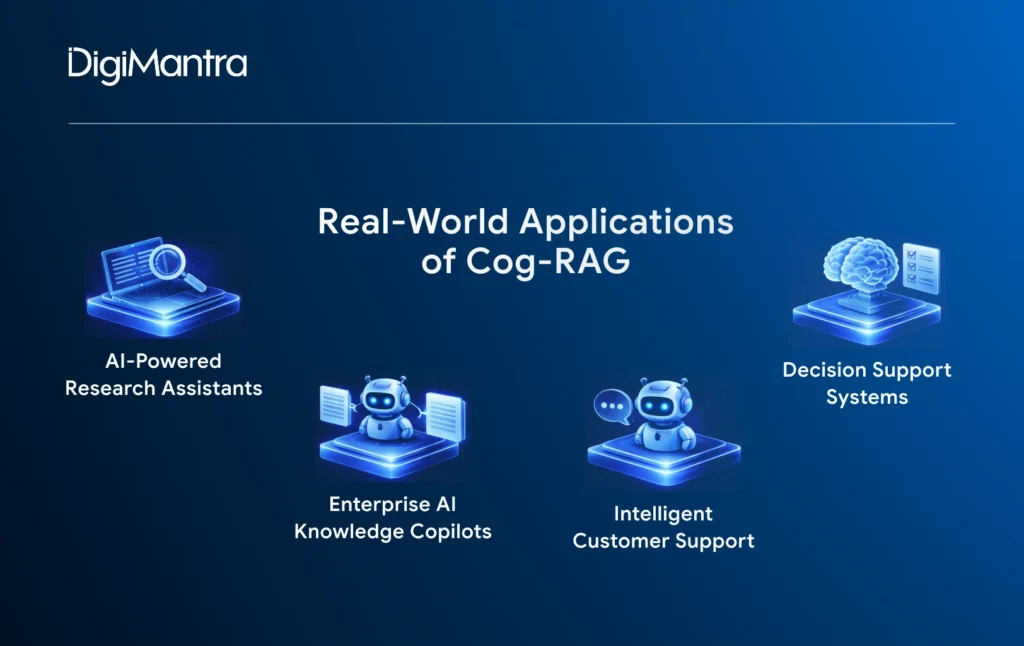
Cog-RAG is particularly useful in environments where questions require reasoning across multiple knowledge sources. Several emerging AI applications benefit from this architecture.
AI-Powered Research Assistants
Researchers frequently ask questions that require synthesising information from multiple studies or datasets. Cog-RAG helps by breaking research queries into structured tasks and retrieving relevant papers for each step.
Enterprise AI Knowledge Copilots
Large organisations often struggle with knowledge fragmentation. Cog-RAG enables AI assistants to determine which internal systems are most likely to contain relevant information before searching.
Intelligent Customer Support
Customer support queries can involve diagnosing technical issues, assessing error logs, and retrieving troubleshooting documentation. Cog-RAG allows autonomous AI agents to reason through possible causes before retrieving solutions.
Decision Support Systems
Business leaders increasingly rely on AI tools to evaluate reports, market data, and strategic insights. Cog-RAG helps these systems gather information more strategically, improving the quality of recommendations.
The Connection Between Cog-RAG and Agentic AI
The rise of Cognitive Retrieval-Augmented Generation is closely tied to a broader trend in AI: the emergence of agentic systems. These systems are designed not just to respond to prompts but to plan and execute complex tasks.
Agentic AI systems require the ability to gather information strategically. They must decide what knowledge is needed before taking action.
Cog-RAG provides this capability by embedding reasoning into the retrieval process. Instead of functioning like a search engine, the AI behaves more like an investigator, identifying what information is required and pursuing it step by step.
As agentic AI continues to evolve, cognitive retrieval strategies are likely to become an essential component of intelligent systems.
Challenges and Considerations
Despite its advantages, implementing Cog-RAG introduces new technical challenges. The architecture is more complex than traditional RAG pipelines and often requires additional orchestration layers to coordinate reasoning and retrieval processes.
Another challenge involves system latency. Because Cog-RAG may perform multiple reasoning and retrieval steps, response times can increase if the architecture is not carefully optimised.
Developers must also design effective strategies for query decomposition in AI and retrieval planning. Poorly structured reasoning steps can still lead to inefficient searches.
However, advances in AI orchestration frameworks and reasoning models are rapidly making these architectures more practical for real-world applications.
Final Thoughts
Retrieval-Augmented Generation fundamentally changed how AI systems access knowledge. By connecting language models to external data sources, RAG enabled more accurate and trustworthy responses.
Yet as AI applications grow more complex, simple retrieval is no longer enough. Systems must also understand how to retrieve information intelligently.
Cog-RAG (Cognitive Retrieval-Augmented Generation) addresses this challenge by introducing a reasoning layer that guides the retrieval process. Instead of searching blindly through massive knowledge bases, the system examines the question, plans its information needs, and retrieves knowledge with purpose.
This shift, from retrieving first to thinking first, may seem small, but its implications are significant. It moves next-generation AI systems closer to behaving like true problem solvers rather than passive search engines.
As enterprises build increasingly sophisticated AI assistants, research tools, and autonomous agents, cognitive AI architectures like Cog-RAG will likely play a central role in shaping the next generation of intelligent knowledge systems.

AI-FIRST ENGINEERING FOR MODERN BUSINESSES
Designed for performance. Powered by innovation.
 Product Development
- Custom Software
 Mobile & Web
- AI & Automation
- Cloud Management
- Intelligent Systems