

Artificial Intelligence (AI) has become an important part of everyday business operations. It supports customer service, sales, software development, data analysis and knowledge sharing. However, when businesses connect Artificial Intelligence with their internal data, new challenge emerge. One of the biggest concerns is preventing AI data leakage and protecting sensitive information while still encouraging innovation.
This risk is not only about major cyberattacks, but also arises from everyday employees’ activities, such as uploading confidential documents or sharing sensitive business information with unauthorised AI tools.
Unauthorised disclosure of sensitive data can occur when AI systems have excessive access to internal information or when application security controls are improperly implemented. Such data may include personal information, credentials, proprietary source code and confidential business information. Sensitive Information Disclosure is classified as LLM02:2025 in the OWASP Top 10 for LLM Applications. This risk can arise from insecure model outputs, unauthorized retrieval, excessive permissions or insecure integrations.
This impact on business can be significant. According to IBM’s research, some companies had an AI-related security incident. Out of those 92% did not have the right controls to manage access to AI systems. In India, the average cost of a data breach went up to 255 million rupees in 2026.
This makes it clear that relying on traditional cybersecurity measures alone is no longer enough. Businesses need a secure AI environment supported by clear policies, controlled access to sensitive data and proper data management practices. Regular security assessments, employee awareness and continuous monitoring are equally important to help organisations protect their information while using AI effectively.
Why Is AI Data Leakage a Growing Business Risk?
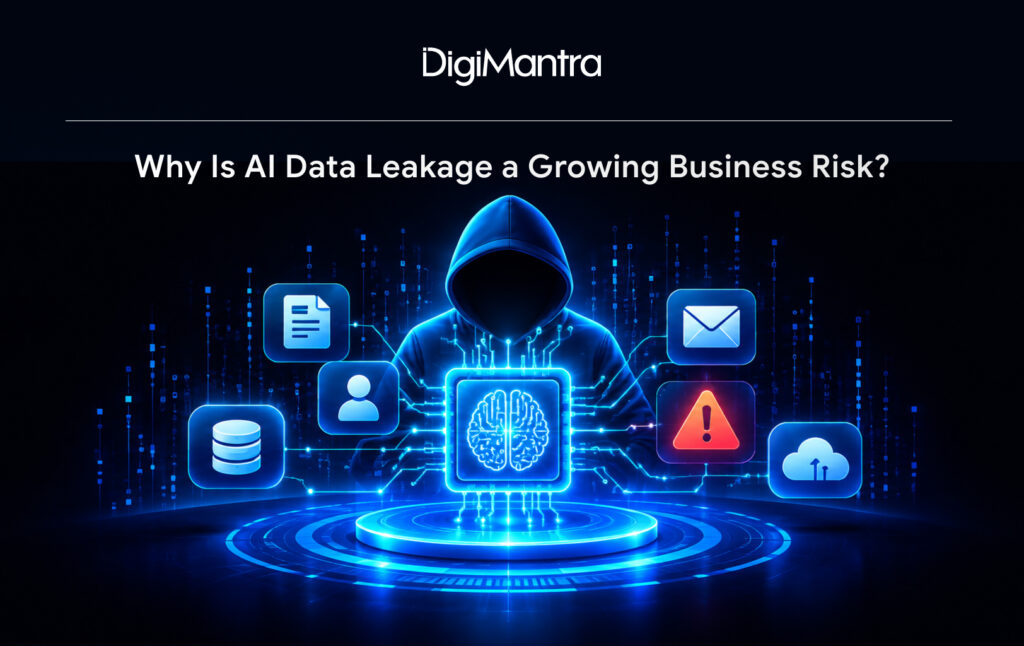
We notice that traditional apps usually work within defined limits. AI systems can blur those limits because they often handle different types of data all at once. This means AI systems can process user inputs, files, emails, databases, APIs, cloud services and other external tools in a single task.
We also see that if an AI assistant connected to company data and the permissions are not set correctly, it may access information that a user should not see. Additionally, if an employee uses a public AI service, they may share company data outside of the organisation’s control without realising it.
These cases show how easily data can slip beyond its intended limits if AI systems are not managed properly.
AI-related security issues are becoming more complicated. According to IBM’s 2026 Cost of Data Breach report, data breaches involving AI often exploit weaknesses such as hacked APIs, vulnerable applications and misconfigured cloud settings. These problems usually do not result from flaws in the AI model itself.
Key Risk Factors:
- Exposing customer information, financial details, medical records, contracts and internal files can lead to serious consequences, as this information is sensitive.
- Sharing proprietary source code, business plans and unique company processes.
- Unauthorised access due to improperly set up AI tools, APIs or agents.
- Data exposure through AI-generated answers, logs, prompts or connected applications.
- Security risks caused by AI tools that are not approved or controlled often referred to as Shadow AI.
Where Can AI Data Leakage Happen in a Business?
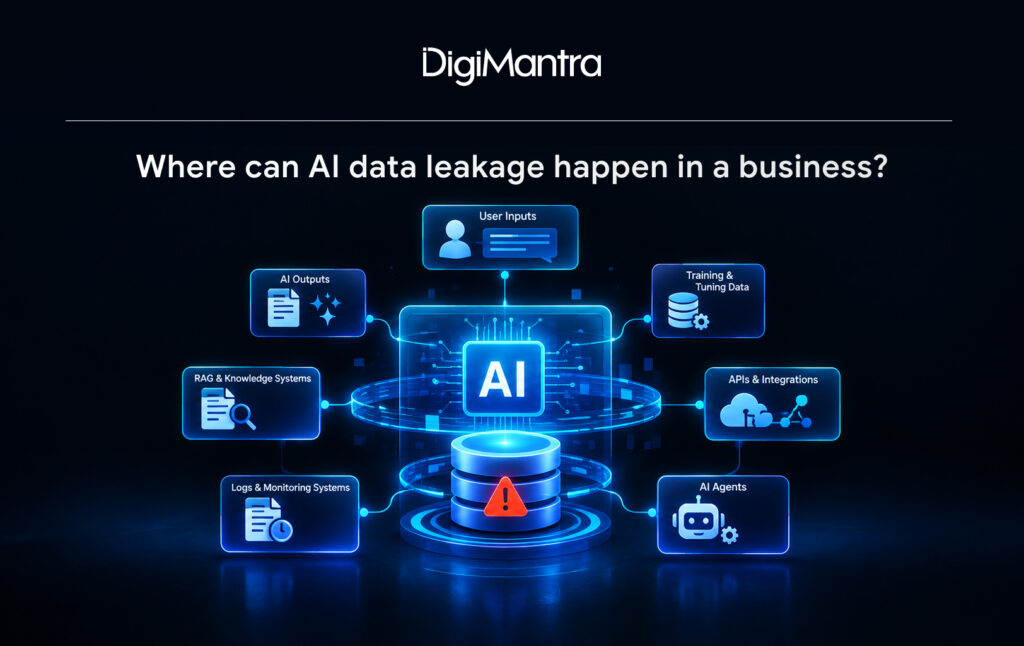
AI data leakage can occur at different stages of the AI development and deployment process. Just looking at the model is not enough because it can miss some security risks.
For example, a company might use an AI model, but data leaks can still happen due to issues such as an improperly configured database, an API that allows unnecessary access, an unsafe plugin, or an employee sharing sensitive information with an external AI service.
Some Common Areas Where Data Leakage Can Happen Include:
- User Inputs: Employees might enter sensitive information, customer details, login details or company documents into AI tools.
- AI Outputs: Sensitive information may appear in AI-generated responses if the system has access to confidential data without proper safeguards.
- Training and Tuning Data: Sensitive information might be included into datasets without proper checks or controls.
- RAG and Knowledge Systems: If access permissions are not configured correctly, documents might be accessed by people who should not have permission to view them.
- APIs and Integration: When systems are connected, they can create opportunities for data to be accessed or shared without proper authorisation.
- Logs and Monitoring Systems: Prompts, responses or activity logs generated by AI tools may contain sensitive information.
- AI Agents: These autonomous systems might use access permissions and credentials that too broad allowing them to access more data than they should.
How Can Businesses Prevent AI Data Leakage?
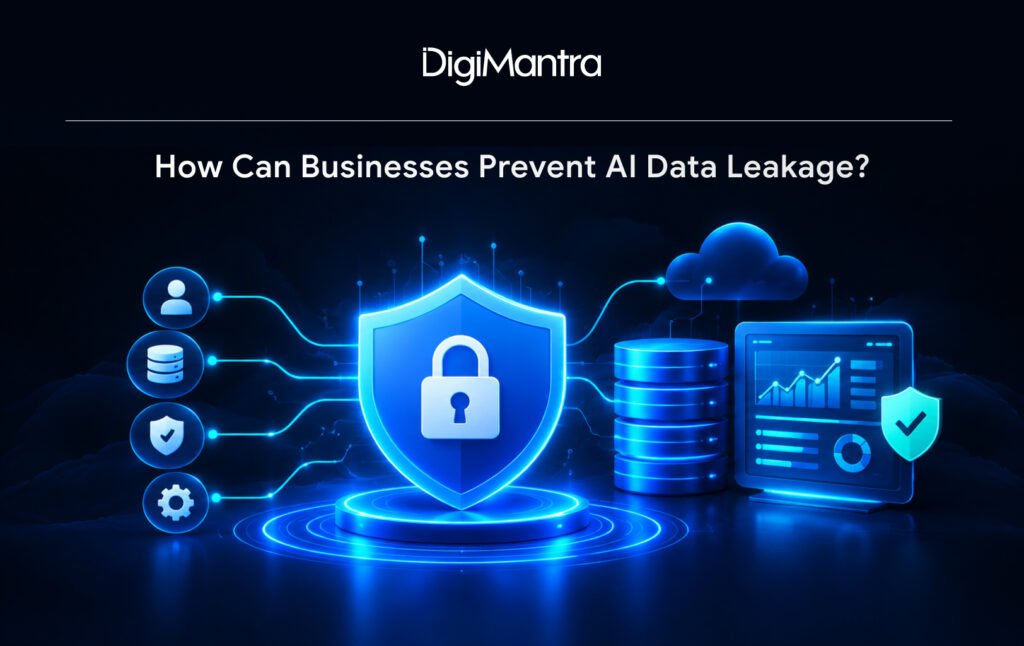 Preventing AI data leakage starts with treating AI as a part of the company’s overall security plan, not just as a tool that helps with work. Companies should establish rules about what information AI tools can access, where that information can be used, who is allowed to work with it and what the system is permitted to do.
Security measures need to be, in place before data is provided to the model and should also cover the stages where data is being processed and results are generated.
Key Strategies Include:
- Classify Data: Classify information before it is handled by AI systems to identify sensitive data and determine how it should be protected.
- Implement Access Controls: Use role-based access controls to ensure users and AI systems can access only the information they need.
- Protect Sensitive Information: Sanitise, redact, tokenise or mask sensitive data wherever necessary to prevent exposure.
- Limit AI Access: Allow AI systems to access only the systems and datasets required to perform their tasks.
- Approve AI Tools: Define which AI tools employees can use and establish clear rules for their use within the organisation.
- Monitor Data Activities: Keep track of how AI interacts with data, how information moves between systems and which other tools are connected.
- Test AI Security: Test AI applications against prompt injection attempts and data extraction risks to identify potential vulnerabilities.
- Establish Data Retention Policies: Set clear guidelines for how long data is retained, when it should be deleted and how vendors process and handle sensitive information.
Data Classification and Access Controls for Secure AI
One of the most important steps in preventing data leaks is understanding what data an AI system really needs. Not all AI projects require access to company database, customer details or internal file collections. Giving an AI application access simply because it is possible can create additional security risks.
Instead, companies should classify data based on its sensitivity and create access rules accordingly.
Publicly available information may require fewer restrictions, while customer records, financial information, non-public source code, passwords and confidential company documents should have much stronger access controls.
Key Benefits Include:
- Least Privilege Access: This means AI systems are given the permissions they need to perform their assigned tasks. This helps reduce unnecessary access and improve security.
- Role-Based Controls: Users can only access the information permitted for their job roles, rather than automatically receiving the full access available to AI systems.
- Segmentation: Important databases and storage areas remain separate from AI activities that involve lower security risks.
- Reduced Blast Radius: If an AI application is compromised, limited access helps reduce the amount of data that could be exposed or stolen.
This is especially important as business adopt AI agents. According to IBM, AI agents act as non-human users that interact with applications, APIs, data and cloud services. This makes managing identities and permissions an important security challenge.
Protect RAG, Vector Databases and AI Integrations
Retrieval-Augmented Generation (RAG) is now widely used by businesses to connect AI with their knowledge resources. It helps make enterprise AI more useful without requiring all company information to be built directly into the model.
RAG also brings its own security challenges. Documents are retrieved, processed, converted into embeddings, stored and then sent to the model’s context. If permissions are not properly configured at the document level, a user might gain access to information simply because the AI system was able to retrieve it.
How Can Businesses Control Shadow AI?
Employees often start using AI tools before a company has established clear rules. They might use chatbots to summarise contracts, analyse spreadsheets, rewrite messages, create code or manage customer data.
This is known as “Shadow AI” when AI tools are used without knowledge or oversight of the company’s management or IT teams. The problem is not employees use AI. The real issue is that security teams may not know which tools are being used, what data is being shared or how these tools handle that data.
According to IBM’s research, Shadow AI is risk for businesses. A good, approved AI framework can offer several benefits:
- Approved AI Tool: A clear list of permitted AI tools and their approved uses.
- Data Handling Rules: Guidelines for managing customer, employee, financial and company data.
- External AI Controls: Controls for external AI services and web-based applications.
- Employee Training: Training of employees on how to use AI safely and understand common security risks.
- Better Visibility: Improved insight into how AI is being used across different parts of the company.
These policies allow employees to use AI effectively while establishing clear rules for handling sensitive information.
Build AI Governance into Every Stage of the AI Lifecycle
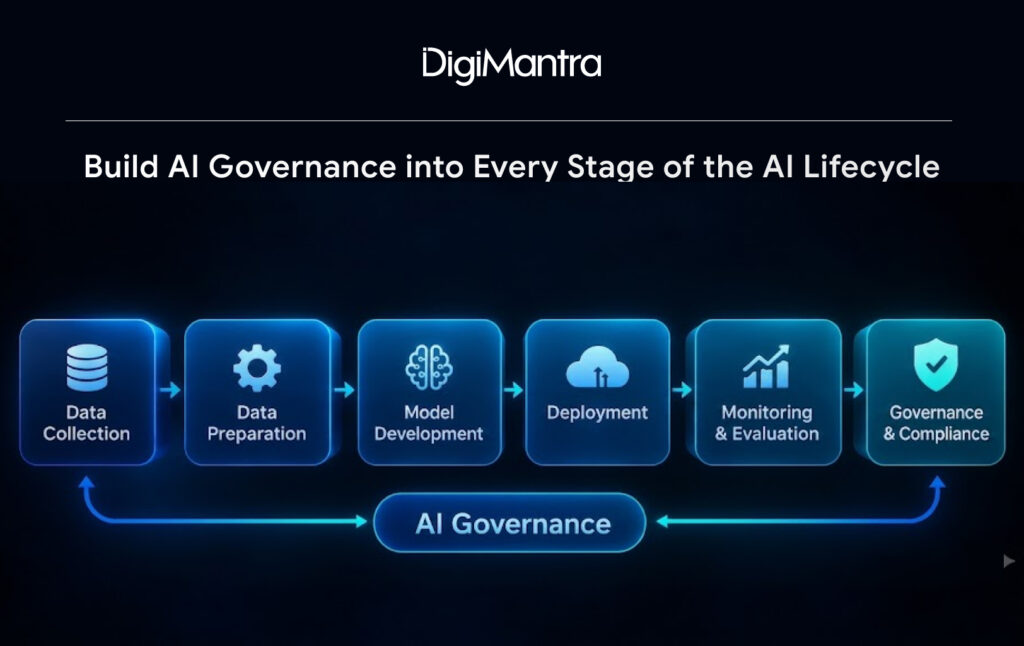
AI security is most effective when it is part of the AI development process from the start. It should not be added after the system is already in use.
Before an AI system is launched, a business needs to determine what data it will use. It must also assess potential risks and decide who will oversee each part of the system. Clear security rules need to be established.
Once the AI system is running, those rules translate into actions such as access controls, monitoring, testing routines and ongoing policies for managing the system.
Even after the AI system is operational, the organisation should continue reviewing and updating its security. That is because models can evolve, integrations and connections can change, data sources can be updated and the way people use AI can change over time.
What It Offers:
- Accountability: Clear responsibility for AI governance, systems, data and security controls.
- Consistent Governance: Consistent governance across business and technical teams.
- Compliance Readiness: Better preparation for privacy and security requirements.
- Risk Assessments: Assessing potential risks before deploying new AI use cases.
- Stronger Coordination: Better coordination between connected systems as they evolve and cybersecurity requirements change.
AI governance is more than just a policy document. It becomes the framework that brings together security, data handling, access controls and the responsible use of AI.
Conclusion
Businesses adopting Artificial Intelligence must make data security a top priority in their AI plans. They should not delay addressing this issue. As soon as AI systems start working with documents, databases, APIs and other business tools, it becomes essential to know who can access what information and how that data is protected.
A solid AI security plan includes classifying data, giving users only the access they need, ensuring integrations are secure, controlling what enters and leaves AI systems, and monitoring activities closely. Companies need to ensure that AI systems access only the data required to perform their tasks and that sensitive information remains protected at all times.
It is also important to consider risks that go beyond the AI model itself. Issues such as prompt injection, faulty retrieval systems, insecure APIs and uncontrolled AI agents can all lead to sensitive data leaks if not managed carefully.
Frequently Asked Questions:

AI-FIRST ENGINEERING FOR MODERN BUSINESSES
Designed for performance. Powered by innovation.
 Product Development
- Custom Software
 Mobile & Web
- AI & Automation
- Cloud Management
- Intelligent Systems